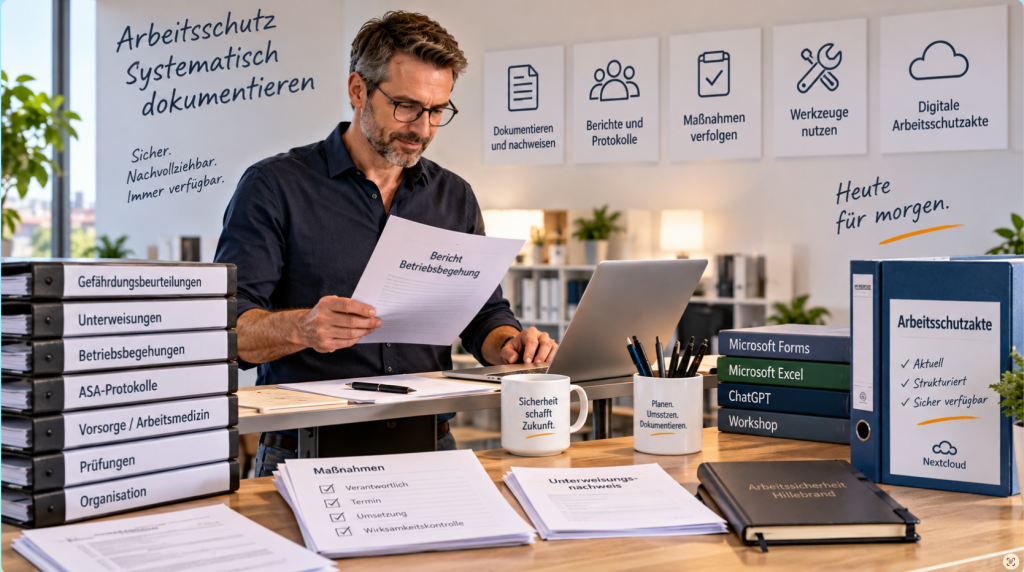
Occupational safety and health must not only be organized and implemented, but also documented in a traceable manner . Hazard assessments, established measures, training sessions, site inspections, meetings, and other occupational safety and health activities generate information that must remain available, up-to-date, and easily accessible within the company.
Good documentation serves more than just as legal proof. It provides a clear overview, highlights responsibilities and pending actions, and makes it possible to systematicallyrather than having to start from scratch every time an issue arises.
At Hillebrand Occupational Safety, documentation is therefore viewed as an integral part of the overall occupational safety process: identify, assess, define measures, implement, monitor, and document.
One of the four key hubs for occupational safety
This page provides an overview of occupational safety and health documentation and directs you to relevant technical articles and practical resources.
In this post
01 – Why Occupational Safety Must Be Documented
There are legal requirements for documentation and record-keeping in numerous areas of occupational safety and health. This is particularly evident in the case of risk assessments: The employer must document the results of the assessment, the measures that were implemented, and the outcome of their review.
Training sessions, occupational health screenings, examinations, and certain organizational requirements also result in the need for documentation. In addition, there are company documents such as reports from facility inspections or meetings of the occupational safety committee.
However, the same format or retention period does not apply to every occupational safety topic. The key factor is what documentation is required for the specific process and makes sense for the company’s organizational structure.
Good documentation, therefore, always answers the following questions:
What was determined? What was decided? Who is responsible? By when must action be taken? And did the measure actually have an effect?
02 – Risk Assessments, Training, and Documentation
A significant portion of occupational safety and health documentation stems directly from statutory and company-specific occupational safety and health processes.
These include, in particular, risk assessments and the measures derived from them, records of training sessions conducted, as well as required documents related to occupational health care and the organization of occupational safety.
Orders and appointments—such as those for occupational safety specialists, company physicians, or safety officers—as well as the delegation of duties and other organizational provisions must also be readily available in an organized manner.
The key here is not to produce as many documents as possible. Rather, good occupational safety documentation should make it clear how occupational safety is organized within the company and how specific measures are developed based on identified needs for action.
03 – Reports and Minutes Make Occupational Safety Transparent
Occupational safety isn’t limited to risk assessments and forms. Many important insights arise in day-to-day operations—especially during site inspections and during Occupational Safety and Health Committee (ASA) meetings. Findings, consultation results, agreed-upon measures, responsibilities, and deadlines should therefore be documented in a traceable manner.
The following provide an overview of the work performed: reports from the occupational safety specialist and the company physician. The Occupational Safety Act requires both to report regularly on the fulfillment of their duties. In practice, these reports can serve as a consolidated account of the key activities and developments in occupational safety.
This creates a clear line of accountability: Site inspections document specific findings and measures, ASA minutes record consultations and agreements, and the annual report summarizes key activities, developments, and areas requiring action.
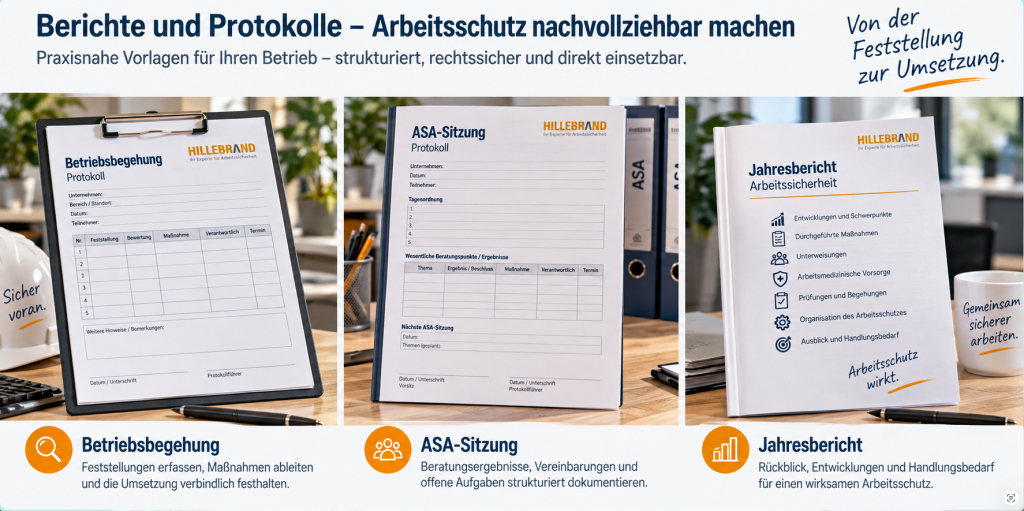
The documents serve different purposes but are part of a common process. They make it clear what has been determined, discussed, and agreed upon, and what tasks have resulted from these discussions. At the same time, they provide a foundation for tracking outstanding actions and identifying trends over a longer period of time.
Reports and minutes transform occupational safety and health activities into traceable tasks and make the next steps in their processing clear.
04 – Systematically Track Actions
Documentation does not end with the identification of a problem. What is crucial is that the identified need for action lead to concrete measures, and that their implementation is tracked in a transparent manner.
Effective monitoring of measures therefore involves the following:
- What was found?
- What measure was agreed upon?
- Who is responsible for implementation?
- By when should the measure be implemented?
- Has the task been completed?
- Was it effective?
The basis for this can be, for example, a risk assessment, a facility inspection, an ASA meeting, a CHECK, a SURVEY, or a workshop. It is crucial that a finding not merely be documented and then filed away.
A structured approach to tracking tasks creates transparency, especially when there are multiple open tasks. Responsibilities and deadlines remain clear, and the status of each task can be checked at any time.
Documentation thus becomes a management tool: from identifying the need for action, through implementation, to monitoring effectiveness.
Action Required at a Glance
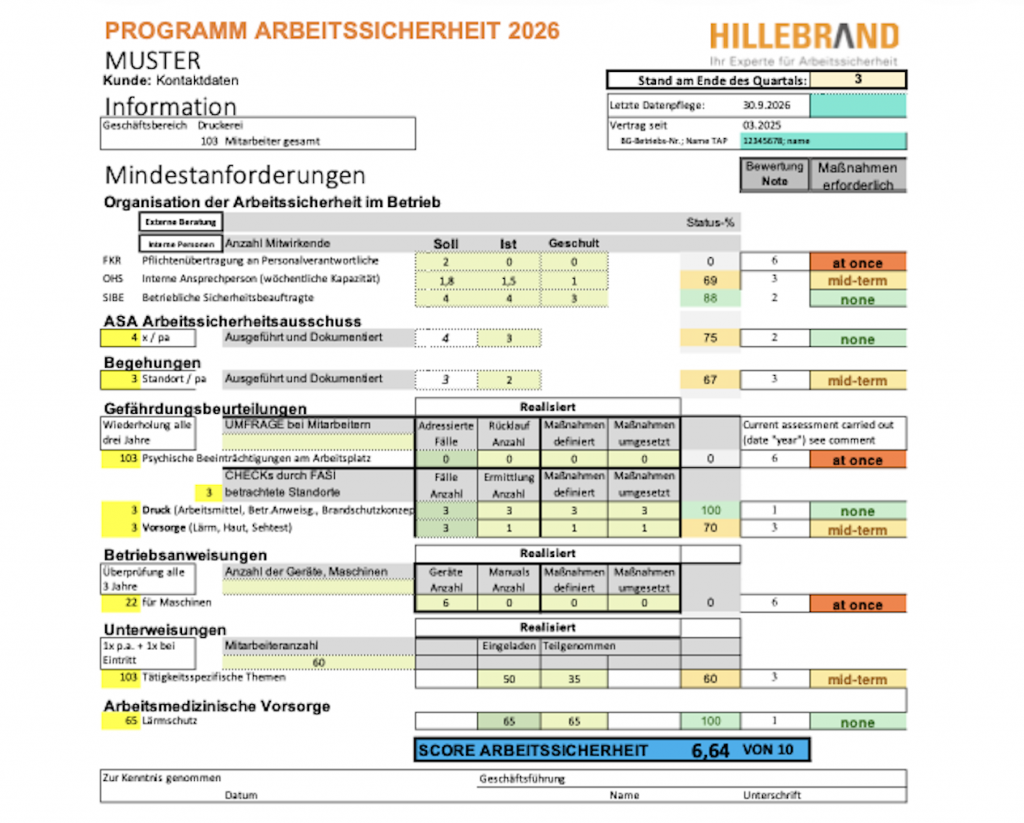
Hillebrand implements the “Occupational SafetyProgram” . It consolidates the target and actual status of workplace safety into a concise overview and enables management, in particular, to quickly identify areas requiring action, pending measures, and progress already made.
This makes occupational safety a basis for decision-making: Priorities become clear, decisions can be made more quickly, and necessary measures can be initiated and tracked in a targeted manner.
05 – Digital Tools for Occupational Safety and Health
Digital tools can significantly simplify occupational safety and health. However, what matters is not the software used, but the role it plays in the occupational safety process. That is why Arbeitssicherheit Hillebrand combines different tools with one another.
Microsoft Forms is used for structured data collection. With a CHECK , working conditions can be documented in collaboration with an appropriate company representative. Using a SURVEY , employees are directly involved when their experiences and perceptions are important for the assessment.
Microsoft Excel helps with the structured analysis of more extensive results. Anomalies can be consolidated, key trends identified, and developments clearly presented.
A workshop serves as a tool in situations where results need to be further refined. Identified problems are described collaboratively, causes are examined, possible solutions are developed, and concrete actions—including assigned responsibilities and deadlines—are derived from these.
Also ChatGPT can support this work—for example, by analyzing and organizing large amounts of information, comparing results, or presenting occupational safety topics in an understandable way. The technical evaluation and the decision regarding necessary measures remain an integral part of the company’s occupational safety process.
This results not in an isolated collection of digital applications, but in a coordinated way of working:
Identify → evaluate → define → assess → determine actions → document.
Digital tools are not meant to make workplace safety more complicated. They are intended to make information available more quickly, highlight connections, and facilitate implementation.
06 – The Digital Occupational Safety and Health Record
Occupational safety generates a large number of documents over the years. Therefore, what matters is not only that these documents exist, but that they are filed in an organized manner, kept up to date, and can be quickly retrieved when needed.
To this end, Hillebrand Occupational Safety provides its customers with a digital occupational safety file in a secure Nextcloud environment . There, the essential occupational safety and health documents are organized according to a standardized structure and kept permanently available.
Here's how collaborative digital document management works in practice:
→ Manage occupational safety documents collaboratively with Nextcloud
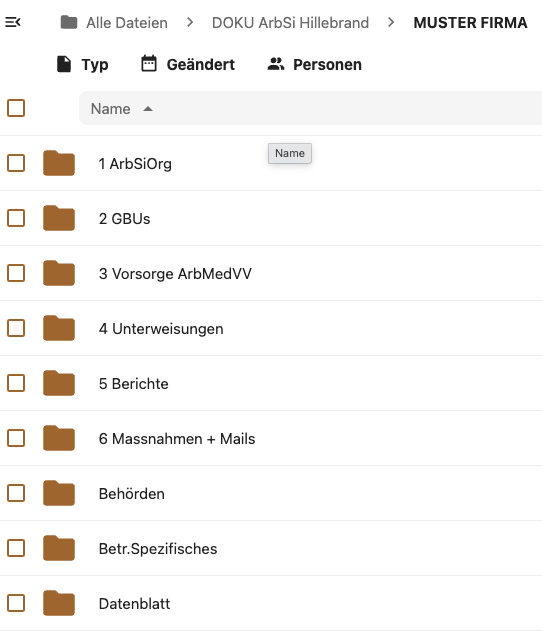
Example of a digital occupational safety file: a standardized folder structure for the ongoing management of a company.
The folder structure does not follow a technical filing logic, but rather the actual tasks of occupational safety:
Organization of Occupational Safety and Health → Risk Assessments → Occupational Health Screening → Training Sessions → Reports → Actions and Correspondence → Government Agencies → Company-Specific Documentation
This is how individual documents are combined to form a comprehensive company occupational safety file. Risk assessments, designations, training records, preventive care documents, site inspection reports, and ASA protocols are not stored in isolation from one another but are organized within a uniform structure and filed where they belong from a technical standpoint.
Documentation thus does not become an archive of past activities, but rather a tool that is available at all times to support ongoing occupational safety efforts.
07 – Documentation Concludes the Occupational Safety Process
Occupational safety is not a process that ends with a risk assessment, a training session, or a site inspection. What matters most is that findings are acted upon and necessary measures are actually implemented.
This results in an ongoing process:
Identify → Assess → Determine actions → Assign responsibility and set a deadline → Implement → Monitor effectiveness → Document
The documentation ties these individual steps together. It shows what has already been completed, where further action is needed, and which topics need to be revisited.
Well-organized occupational safety documentation does not create more bureaucracy. On the contrary: it prevents insights from being lost, tasks from being started over, or agreed-upon measures from falling by the wayside in day-to-day operations.
In this way, individual activities are transformed into a systematically organized and consistently traceable occupational safety program.
Do you have a question about workplace safety?
Please briefly describe your request. I will get back to you personally.