

Occupational safety and health training is a key component of workplace safety and health.
Hazard assessments, protective measures, and workplace rules can only be effective if employees know what hazards exist in their work, what protective measures are in place, and how they should behave safely.
Training must therefore be be understandable, task-specific, and practical . Office workers require different training content than those working in a workshop, a kitchen, or in the field. What matters is not a standard training program that is as general as possible, but rather conveying the hazards and protective measures relevant to the actual job.
On this page, you’ll find an overview: What requirements apply to training? What do occupational safety authorities and workers’ compensation insurers expect? When is digital training appropriate—and how can content, knowledge assessments, and documentation be combined into an effective training system?
One of the four main topic pages on occupational safety
This page provides an overview of occupational safety training and directs you to relevant in-depth articles and practical resources.
In this post
01 – When and why must employees receive training?
The employer must inform employees about occupational safety and health . The training must be tailored to the specific workplace and the specific tasks involved. In particular, it must be provided required upon hiring, when there are changes in job responsibilities, and when new work equipment or technologies are introduced and must be adapted as hazards evolve.
In addition, training sessions must be repeated on a regular basis. DGUV Regulation 1 requires that they be repeated at least once a year. However, it is not merely a matter of adhering to a schedule: if tasks, work procedures, or hazards change, the training must also be adjusted accordingly.
Training combines risk assessment with workplace practices: Employees must be made aware of the identified hazards and the established protective measures. They should know what the rules are, why they apply, and how to work safely in their specific jobs.
→ Learn More: Occupational Safety and Health Training—Requirements, Timing, and Refresher Courses
02 – What must effective training accomplish?
Training should not only inform employees, but also enable them to identify hazards and correctly apply protective measures in their day-to-day work. To achieve this, the content must be understandable, specific, and tailored to the actual tasks and working conditions.
Effective training, therefore, does not merely convey what to keep in mind, but also why a rule or safety measure is necessary and how it is implemented in practice. Good training combines basic knowledge with typical hazards, concrete examples, and clear guidelines for action.
What matters is not a signature on a participant list, but rather that the content has been understood and supports safe practices. An appropriate knowledge assessment can also help to verifiably determine and document that understanding.
→ Learn more: What makes for good occupational safety training?
03 – What Do Regulatory Authorities and Auditors Expect Today?
An occupational safety inspection is not just about whether training sessions have taken place. It is also crucial whether the company has systematically organized the training: Is the content appropriate for the respective tasks? Are the required employees being reached? Are the implementation and results documented in a traceable manner?
With the statutory minimum inspection rate of at least 5% of workplaces annually , the company’s occupational safety and health management system takes on even greater importance. Supervisory authorities focus in particular on risk assessments, responsibilities, training, documentation, and the practical implementation of occupational safety and health measures.
An attendance or signature list primarily documents participation—but it does not yet serve as proof of the quality and effectiveness of the training. Companies should therefore be able to clearly demonstrate who was trained, when, on which job-related topics, and how the training was documented.
→ Learn more: What do occupational safety authorities check during training sessions?
04 – Why isn't a petition alone enough?
A sign-in sheet can document who participated in a training session and when it took place. However, it says little about what content was covered, whether it was relevant to their actual work, and whether the employees understood the essential safety measures. Our training system highlights precisely this distinction.
Reliable documentation should therefore make the training itself transparent: Who was trained, when, on what topic, and based on what content? For digital training sessions, the module, version, and the results of a knowledge assessment can also be documented. This provides significantly more meaningful evidence than a participant’s signature alone.
It is not the signature that ensures safety—but rather a thorough understanding of the content. The documentation serves as proof that training has been provided; its actual purpose is to empower employees to act in a way that ensures their safety and protects their health.
→ Learn more: Documenting training—what should proper documentation include?
05 – Activity-Based Rather Than “One Film for Everyone”
Training must cover the actual tasks and hazards faced by employees . A general, standardized training program for the entire workforce often cannot meet this requirement: Office workers are exposed to different hazards than employees in a kitchen, in a warehouse, in building services, or in the field.
That is why our training system follows a modular, job-specific structure. Separate training modules are available for different work areas—for example, for office and computer-based work, working from home, food service and kitchen operations, the hospitality industry, warehousing and logistics, electrical engineering, and skilled trades. Depending on the workplace, multiple modules can be combined.
Not one video for everyone—but content tailored to each specific job. This ensures that employees receive exactly the information and guidelines they need for their specific work.
→ View training modules and areas of responsibility
06 – Digital Training: What Is Permitted and Practical?
Training sessions do not necessarily have to be conducted as traditional in-person sessions. Much of the content can also be delivered digitally.
What matters is not the medium, but rather that the instruction is understandable, task-oriented, effective, and documented in a way that is easy to follow.
Digital training is particularly well-suited for content that involves knowledge, hazards, protective measures, and rules of conduct are conveyed. For hands-on activities or specific hazards, however, a supplementary in-person training or hands-on instruction on-site may be required or advisable. Digital and in-person training are therefore not mutually exclusive but can complement each other in a targeted manner.
A good digital system also offers organizational benefits: Employees can complete training sessions at their own convenience, independent of group training sessions . Content can be provided in a standardized format, repeated, and combined with knowledge assessments and documentation.
Digitization does not replace the employer's responsibility—but it can help the employer organize training in an effective, consistent, and transparent manner.
→ Learn more: Digital Training in Occupational Safety—Possibilities and Limitations
07 – Hillebrand's Training System
The Hillebrand Occupational Safety Training System combines technically sound content with digital knowledge transfer, knowledge assessment, and transparent documentation. The training courses are modular in structure and can be tailored to a company’s specific activities and hazards.
Each training topic follows a consistent structure: A detailed, full-length version conveys and reinforces the necessary knowledge. A professionally produced instructional video explains the key concepts in a clear and practical way. Afterward, a knowledge quizchecks whether the key points have been understood. Participation and results are documented and confirmed with a corresponding certificate .
The result is more than just a collection of training videos: a comprehensive, modularly expandable training systemthat combines professional quality, clear instruction, and the employer’s organizational requirements.
Read → Observe → Understand → Test your knowledge → Demonstrate.
→ Learn about the training system and the available modules
08 – Modules, Trailers, and Specific Applications
The training system is modular in design. Companies do not choose from a rigid, all-in-one package; instead, they receive the training that is tailored to their workplaces and activities. This includes, for example, modules for office and computer work, working from home and mobile work, project and software work, kitchen and food processing, service, catering and event logistics, the hospitality industry, electrical engineering, and emergency response planning.
Within a company, different modules may be required simultaneously. For example, a hotel needs reception, housekeeping, the kitchen, administration, and building services each require different content. The modules can therefore be selected and combined with one another according to the company’s operational structure.
For selected training sessions, we provide short trailers . These provide an immediate preview of the content, language, and quality of each training session. This allows companies to assess, even before making a selection, how their employees will be engaged and how the content is presented.
The job determines the content—the modular system provides the appropriate training.
How a Training Module Works
Each training module combines four coordinated elements—from a comprehensive knowledge base to a documented completion.
01 LONG TEXT
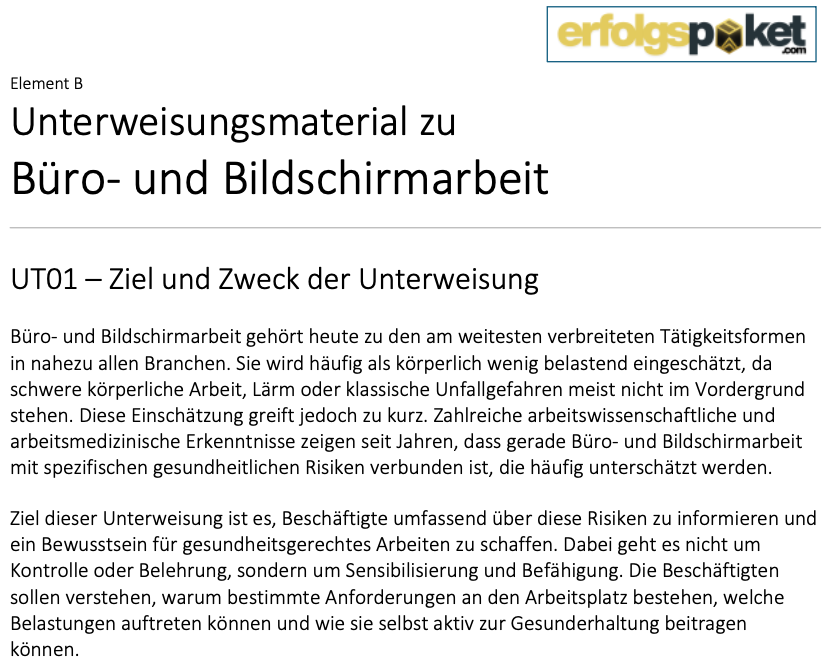
Technically sound instructional materials for reading and reference.
02 VIDEO

The key concepts are presented in a clear, concise, and practical manner.
03 KNOWLEDGE QUIZ
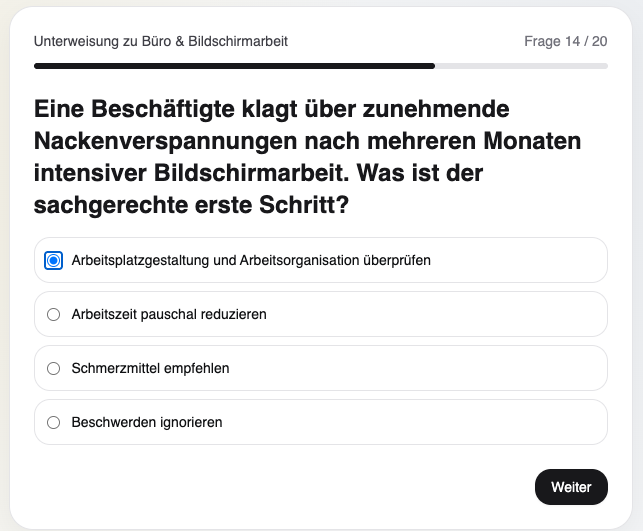
Practical questions test whether the key concepts have been understood.
04 CERTIFICATE
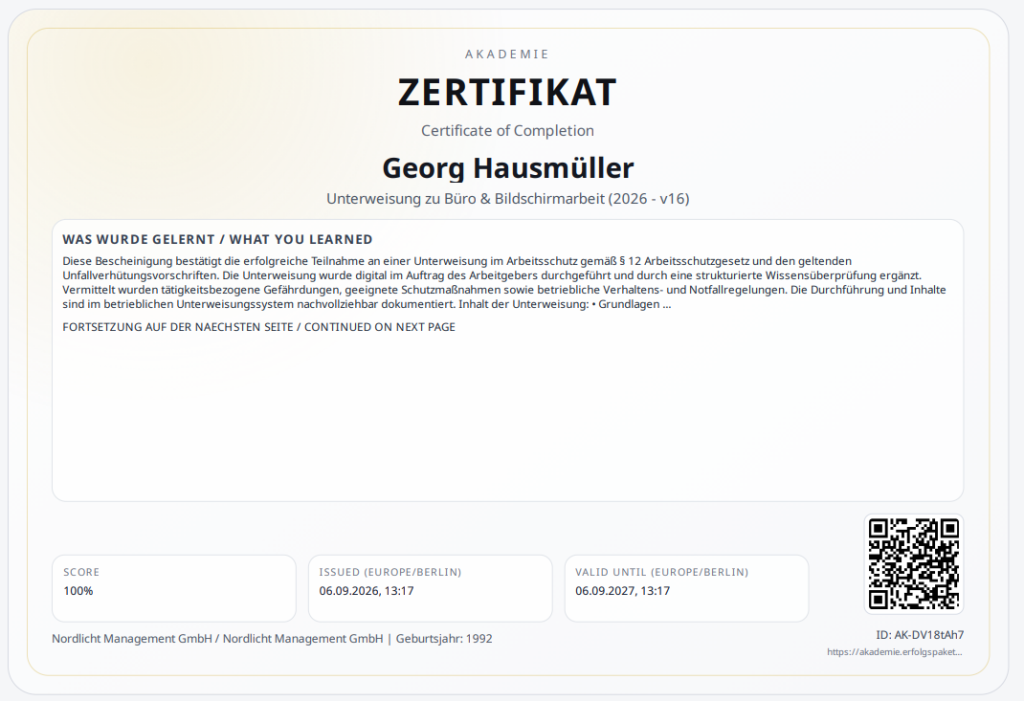
Successful completion is documented on an individual basis and verified in a transparent manner.
Available Training Modules
The training system currently includes 12 completed training topics with 13 available modules. The modules can be selected individually and combined with one another based on a company’s activities and areas of work. Short previews are available for selected modules.
The Office & Modern Ways of Working
Office & Computer Work ▶ Watch the Trailer
Office & Computer Work – English
Working from Home & Remote Work ▶ Watch the Trailer
Project & Software Work
Food Service & Hospitality
Kitchen & Food Processing ▶ Watch the trailer
Waitstaff & Server Duties ▶ Watch the trailer
Catering & Event Logistics ▶ Watch the trailer
Hygiene & HACCP ▶ Watch the trailer
Hospitality Industry – Overall Operations
Specific Activities & Hazards
Psychological Stress / Working in Public Spaces
Electrical Engineering
Emergency Management & First Aid Organization
09 – Documentation, Knowledge Assessment, and Verification
Good training does not end with the last sentence spoken. The employer must be able to provide clear documentation of who was trained on which topic and when. For digital training sessions, this proof can be systematically linked to the respective module and its version number.
Hillebrand's training system supplements knowledge transfer with a digital knowledge assessment. Depending on the module, employees answer practical and job-related questions about the material covered. The passing score of 75 percent; if the assessment is not passed, it can be retaken.
Upon successful completion, the following will be participation, results, and the date will be documented. The employee receives an individual certificate; the company also receives a digital tabular record of participation . This ensures that the topic, version, date of participation, and result remain traceable and accessible.
Provide instruction → Assess understanding → Document participation → Obtain proof.
→ Learn more: Knowledge Assessment and Documentation of Digital Training Sessions
10 – FAQs & Related Articles
In day-to-day workplace practice, specific questions repeatedly arise regarding occupational safety training: Are digital training sessions permitted? How often must training be provided? What does “task-specific” mean? Is a digital certificate sufficient as proof? When is additional hands-on training required?
In our FAQ section , we answer the most important questions regarding legality and admissibility, content and quality, organization, documentation, data protection, and technology. In-depth articles explore specific topics in greater detail and provide employers and decision-makers with concrete guidance for implementation in the workplace.
This also includes the training of company officials: Safety officers must be suited to their role and appropriately qualified. In the case of internationally diverse workforces, training in English may also be required or advisable.
Step by step, this creates a knowledge platform dedicated to workplace training —from the legal foundations and practical implementation to digital organization and documentation.
Read through the information briefly, delve deeper into the topics that interest you, and then choose the right solution for your business.
→ View FAQs on Training Sessions
→ All technical articles on the topic of training
Training System for Your Company
The training a company needs depends on the activities, hazards, and operational structures .
That is why we tailor the training system to suit your company’s needs—from individual modules to combinations of several job-specific training sessions.
You will receive expertly prepared training content, professional training videos, knowledge assessments, and documented proof of participation all within a single, unified system. Employees can access the modules at their convenience via smartphone, tablet, or computer.
Would you like to know which training modules are right for your company?
We’ll help you choose and put together a combination of modules that’s right for you.