Risk Assessment of Psychomental Stress Using CARRARA
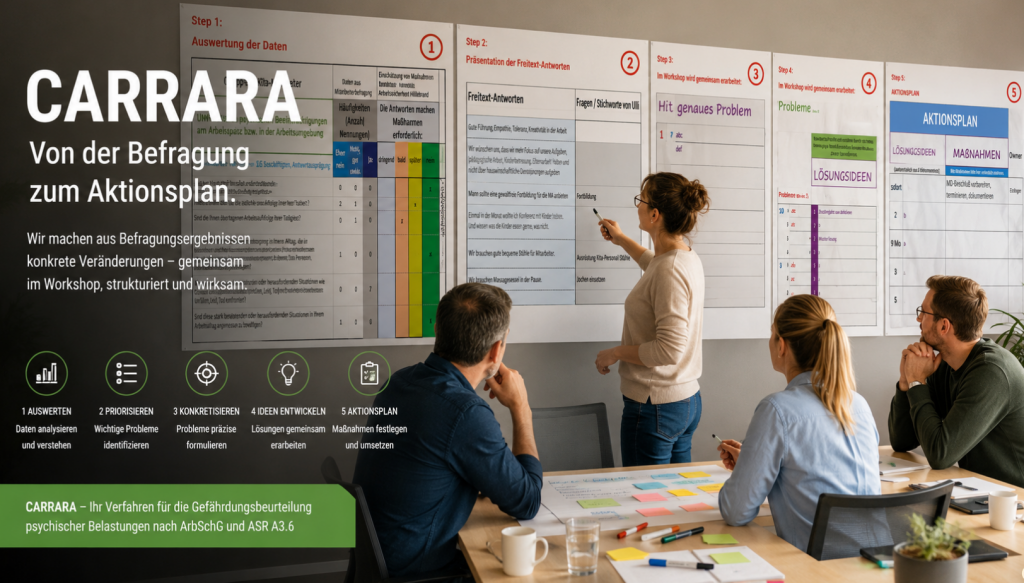
CARRARA – From Survey to Effective Action
CARRARA is a comprehensive process for assessing the risks associated with psychological and mental stress—ranging from anonymous employee surveys and structured analysis to facilitated workshops and effectiveness monitoring.
The survey is based on a field-tested tool developed by the BGW. However, the survey results alone do not constitute a complete risk assessment. CARRARA processes the anonymized responses in a structured manner, highlights anomalies, and systematically incorporates free-text responses.
This is how answers become insights—and insights lead to concrete operational changes.
In this post
01 A Comprehensive Approach to Risk Assessment of Psychomental Stressors
Employers are required to take psychological and mental stress into account in their risk assessments. Section 5 of the Occupational Safety and Health Act expressly lists psychological stress at work as a potential hazard.
CARRARA offers a tried-and-true, end-to-end process for this purpose: from the anonymous identification of stressors, through their structured analysis and expert assessment, to the development and implementation of concrete measures and the subsequent monitoring of their effectiveness.
CARRARA uses the screening procedure of the German Social Accident Insurance Institution for the Health and Welfare Services (BGW). The BGW guidance document
“Focus on Mental Health – BGW Guidance on Risk Assessment for Psychological Stress”
It is based on the recommendations of the Joint German Occupational Safety and Health Strategy and addresses six key areas: job content and tasks, work organization, working hours, social relationships, work equipment, and the work environment.
This means that the employer does not receive a standalone questionnaire, but rather a clearly structured process from assessment to verifiable operational improvement.
CHECK or SURVEY? Not every hazard is identified using the same method. In this article, we explain when a structured assessment with a company representative is sufficient and when employees themselves should be surveyed “CHECK or SURVEY? Two Methods for Identifying Hazards” →
A) Collection
Conduct an anonymous survey of employees
B) Analyze
Data Becomes Insights
C) Modify
Insights Lead to Action
A field-tested survey instrument
Systematically organize results
Developing Concrete Changes in the Workshop
A) Collection
Employees provide the crucial information.
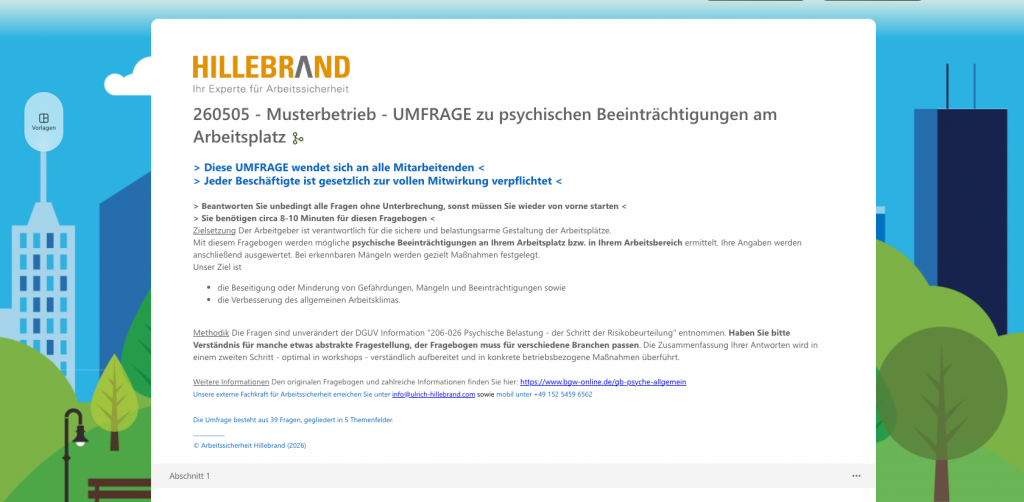
The risk assessment begins with an anonymous employee survey. CARRARA uses a field-tested survey tool developed by the BGW for this purpose, which systematically captures relevant characteristics of working conditions.
Employees evaluate their actual work situation and can provide additional comments in the free-text fields.
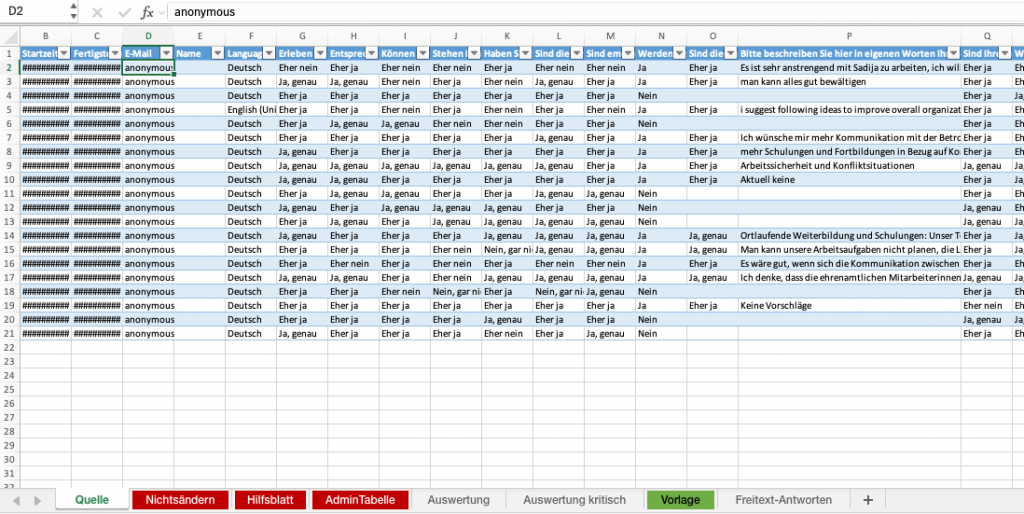
The result is a structured and anonymous dataset derived from real-world business practices.
B) Analyze
Analyzing a survey on psychological stress: CARRARA aggregates the anonymized responses, highlights notable response patterns, and organizes the free-text comments in a structured format for further expert evaluation.
Answers lead to insights.
A survey initially yields a large number of individual responses—but not yet a complete risk assessment.
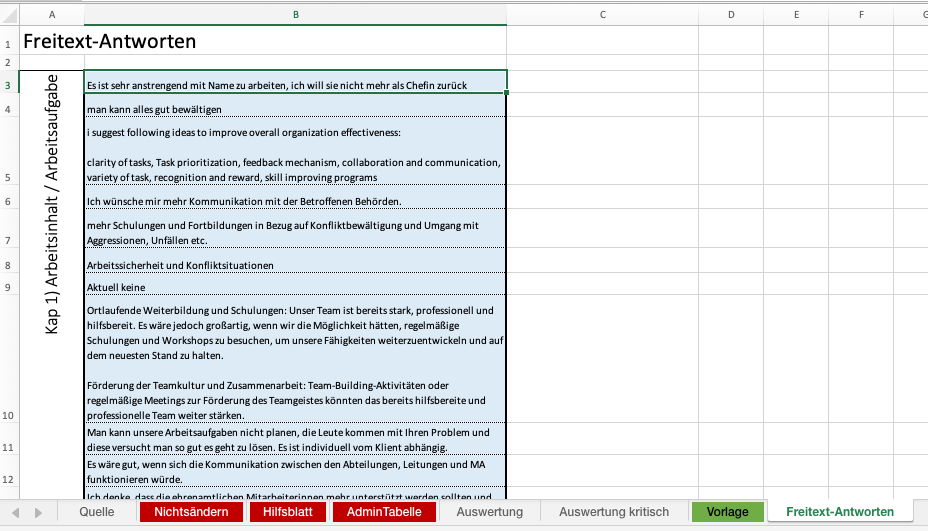
CARRARA compiles the results regarding relevant findings, thereby laying the groundwork for further expert evaluation. The free-text responses, in particular, provide additional insights into specific operational causes and correlations that can be specifically addressed during the workshop.
In this way, the survey data serves as a clear working basis for the technical evaluation and collaborative discussion during the workshop.
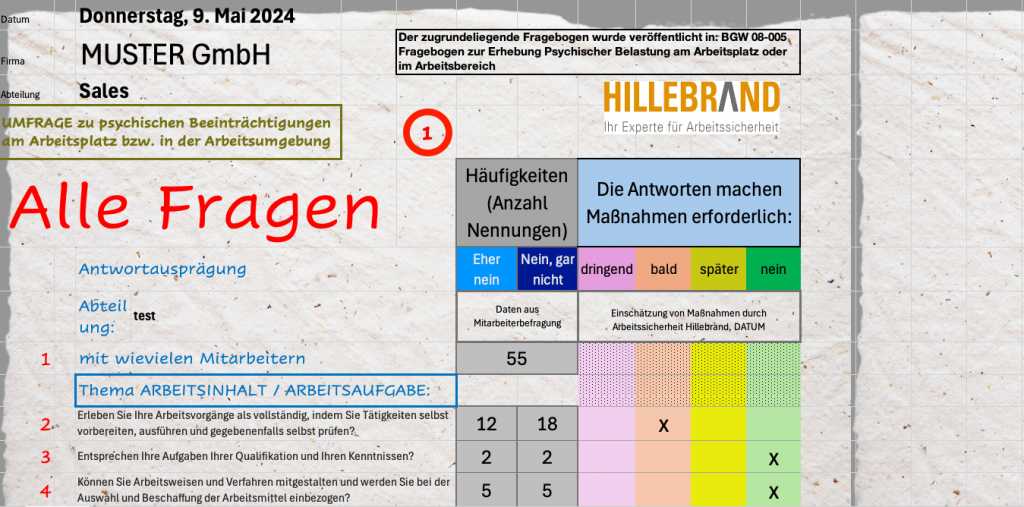
The open-ended responses, in particular, provide additional insights into specific operational causes and correlations that can be specifically addressed in the subsequent evaluation and workshop.
C) Modify
Insights lead to concrete operational changes.
Striking survey results show, first of all, where action may be needed. However, to implement effective measures, it must be clarified exactly what the problem is and what is causing it.
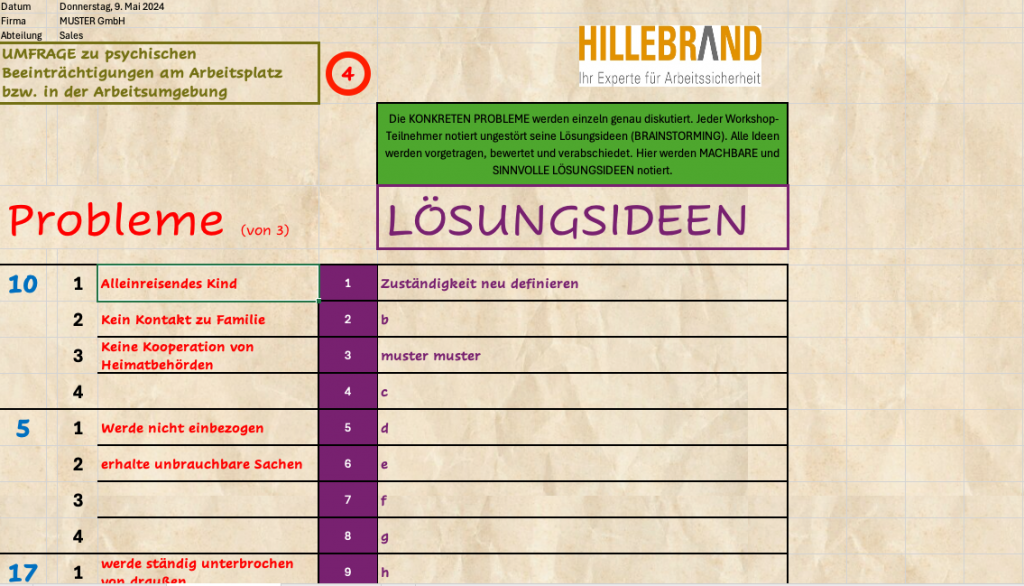
For this reason, the relevant topics are prioritized and defined in detail during the facilitated CARRARA workshop. Subsequently, appropriate solutions are developed, binding measures are established with designated responsible parties and deadlines, and their effectiveness is later evaluated.
In this way, CARRARA manages the risk assessment process from data collection through to verifiable operational changes.
02 In the workshop, the findings are turned into concrete actions
The processed survey results are reviewed collaboratively—from prioritizing the relevant stressors to developing a binding action plan.
Practical Application & In-Depth Analysis:
The article explains when hazards can be identified using a structured CHECK and when employees’ experiences should be incorporated through a SURVEY “CHECK or SURVEY? Two Methods for Identifying Hazards” →
In this post, I explain how to prepare and structure a workshop so that it yields reliable results “How toProperly Prepare a Workplace Safety Workshop—From the Survey to the Action Plan.”
A) Present
Present processed results and free-text entries
B) Prioritize
Prioritize Relevant Stresses
C) Specify
Describe problems precisely
D) Develop Solutions
Working Together to Develop Appropriate Solutions
E) Action Plan
Determine Actions, Responsible Parties, and Deadlines
A) Presenten
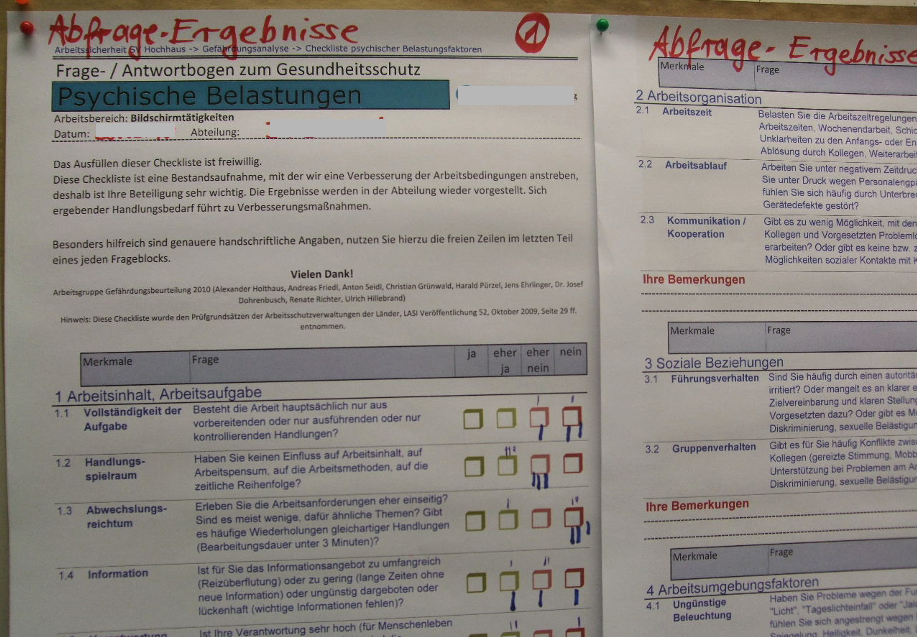
The compiled results will serve as the starting point for the workshop.
To begin with, the results of the survey and the structured open-ended responses are presented. Prominent themes and identifiable areas of stress are highlighted for group discussion.
This provides all stakeholders with a common basis for the subsequent prioritization.
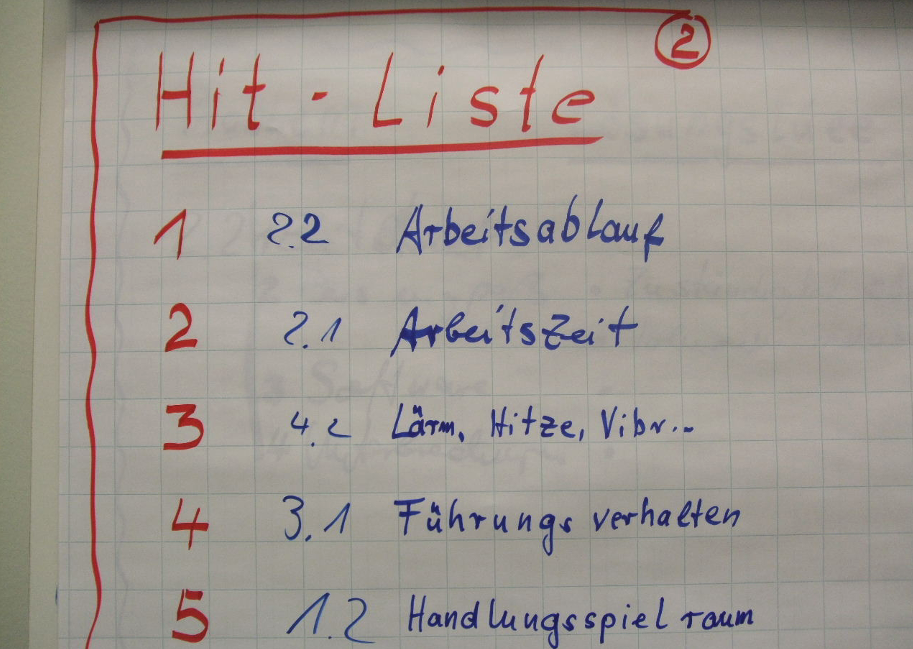
B) Prioritize
The relevant issues are prioritized jointly.
The notable findings and insights from the survey are reviewed collectively and prioritized based on their importance. This results in a priority list of topics that should be addressed first.
C) Specify
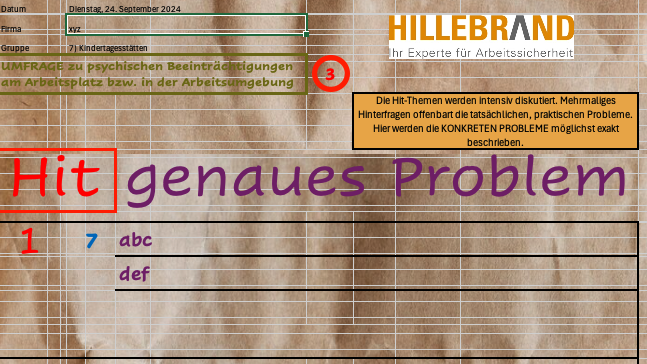
A tip becomes a clearly described problem.
A prioritized topic is initially just a suggestion. In the workshop, participants will therefore work together to clarify exactly what the problem is, when and how it arises, and who it affects. Only a precise problem statement lays the foundation for appropriate solutions.
D) Develop Solutions
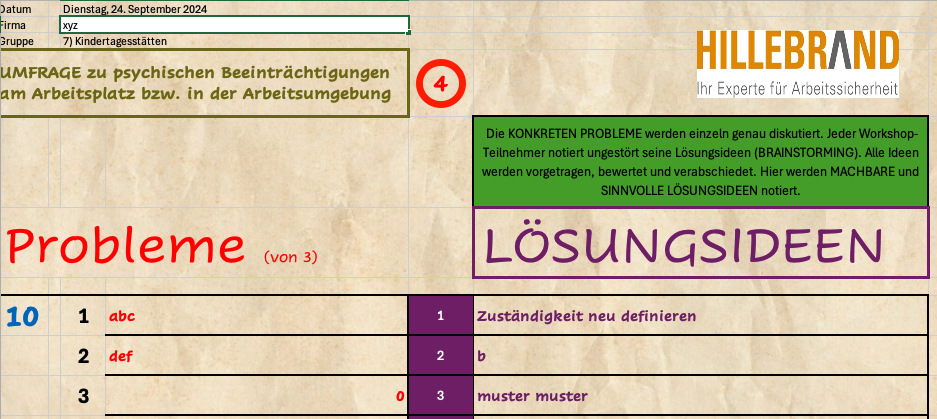
Specific solutions are sought for specifically described problems.
During the workshop, participants will work together to develop suitable solutions to the precisely described problems. Participants will draw on their experiences from their day-to-day work and gather practical suggestions that can effectively reduce the identified stressors.
E) Action Plan
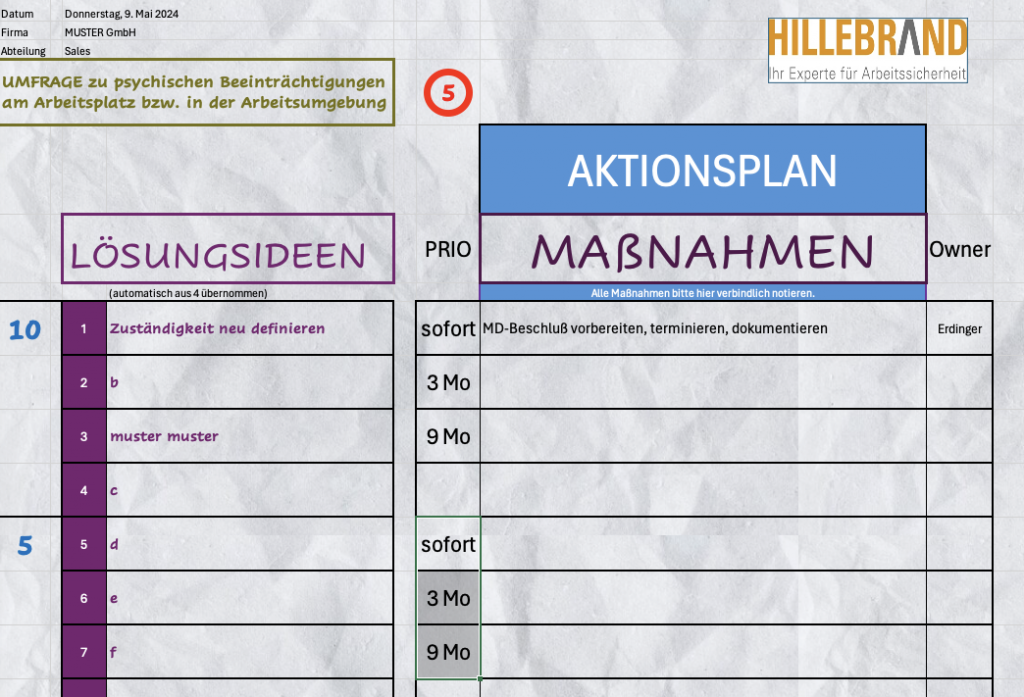
Solution ideas are turned into binding measures.
The selected solutions will be incorporated into an action plan. Measures, responsibilities, and deadlines are set in a binding manner.
This is how the jointly developed solutions are turned into binding operational measures.
F) Check effectiveness
And then what? Check to see if the measures are working.
The risk assessment does not end with the action plan. After implementation, a review is conducted to determine whether the agreed-upon measures have actually reduced the identified risks.
Depending on the topic, the effectiveness is assessed through employee feedback, in discussions or workshops—or through a follow-up survey.
In this way, the survey becomes a comprehensive and verifiable operational improvement process.
Implementing a Risk Assessment of Psychomental Stress as a Project?
I can assist you with surveys, data analysis, and facilitated workshops—all the way through to developing concrete actions and evaluating their effectiveness.