

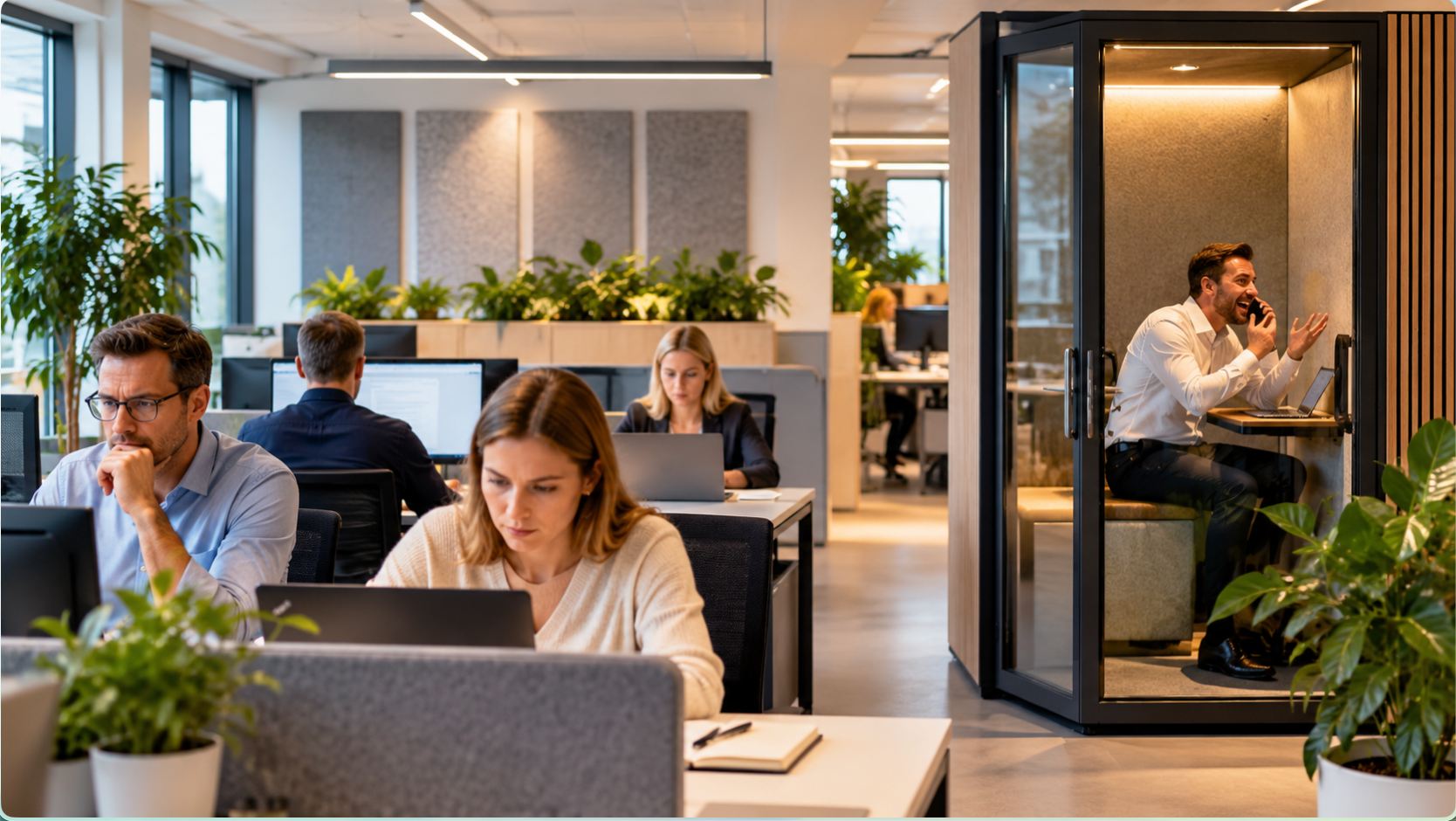
Conversations, phone calls, and various activities can significantly disrupt concentrated work in the office. Good office acoustics, therefore, don’t start with sound absorbers—they begin with the planning of spaces, workstations, and activities.
In this post
01 Why Office Noise Doesn't Always Have to Be Loud
Noise in the office doesn't just start when sound levels get high. Conversations, phone calls, keyboard clicks, and other work-related noises can also be quite distracting—especially when a task requires a high level of concentration.
What is often particularly distracting is intelligible speech. Our brains process conversations in our surroundings almost automatically. Anyone writing a complex text, performing calculations, programming, or engaging in other tasks that require concentration can therefore be repeatedly pulled away from their work by even a single phone call at a neighboring workstation.
Therefore, the decisive factor is not just the question: How loud is it in the office? Equally important is: What tasks are being performed, and how susceptible are they to disruption?
An office doesn't have to be particularly loud to significantly disrupt concentrated work.
02 First, consider the tasks—then assign the jobs
When planning an office, therefore, the first question shouldn't be: “How many desks will fit in the room?” The key question is first: what activities are to take place there simultaneously.
A typical example: Six employees work together in an office. Five of them need to maintain a high level of concentration for extended periods. Another person frequently makes phone calls, engages in spontaneous conversations, and coordinates closely with customers or colleagues. None of these activities is problematic on its own— but their immediate spatial proximity is problematic.
This is exactly where good office planning begins. Activities with different acoustic requirements should be separated from one another as much as possible. This can be achieved, for example, through zoning, sufficient spacing, acoustically effective barriers, separate meeting areas, or phone and meeting booths can be used.
The cubicle shown on the cover is therefore not merely a piece of modern office furniture. It can serve as a concrete organizational and acoustic measure: phone calls and brief meetings are kept out of the area designated for focused individual work.
Good office acoustics don't start with soundproofing materials—they start with the proper allocation of space, workstations, and tasks.
03 Consider Office Acoustics as Early as the Planning Phase
The best way to avoid disruptive noise in the office is to before moving in. As long as walls, doors, workstations, and furnishings are still being planned, different activities can be physically separated from one another. Later on, this is often only possible with additional effort.
Office planning should not be based solely on room sizes and the number of workstations planned. It is also crucial to consider how employees actually work: Who needs quiet and concentration for extended periods? Who makes frequent phone calls? Where do spontaneous discussions take place? Which employees regularly work together, and which activities should be acoustically separated from one another?
The spatial layout can be developed based on this analysis of work activities. Areas designated for focused individual work should, whenever possible, not be located immediately adjacent to frequently used communication areas. Meeting rooms, phone booths, or other private spaces can accommodate conversations that would otherwise take place in an open-plan office. Traffic routes, printer and copier areas, and other regularly used facilities should also be arranged in such a way that they interfere as little as possible with focused work.
Only then does the actual room acoustics design. Ceilings, walls, floors, furniture, and, if necessary, additional sound absorbers all influence how much speech and other sounds propagate throughout the room. Especially in larger or open-plan office areas, it is therefore not enough to simply add individual sound-absorbing elements after the fact. Room layout and acoustic design must be considered together.
The point is not to make an office as quiet as possible. The goal is a work environment in which each task can be performed without avoidable acoustic disturbances.
Good office acoustics are planned—not tacked onto the wall after the fact.
04 What Makes for Good Acoustics in an Office
Whether an office feels acoustically pleasant or disruptive does not depend solely on how loud individual sounds are. Equally important is how sound propagates through the room and how long it remains audible there.
Hard surfaces such as glass, concrete, smooth walls, or other sound-reflecting surfaces bounce sound back into the room. As a result, conversations, phone calls, and work-related noises can remain audible over long distances. In a poorly designed office, this can quickly lead to a background noise level that causes employees to disturb one another.
Good room acoustics therefore aim to limit the propagation of disruptive noise. Sound-absorbing ceilings, wall surfaces, appropriate furniture, acoustically effective partitions, or other absorbers can help achieve this. The key is not to install as many acoustic elements as possible, but to place them where they are most effective for the room’s specific use.
Of particular importance is speech intelligibility over longer distances. What is desirable in a conference room can actually become a problem in an open-plan office: A colleague’s clearly audible phone conversation automatically draws attention and disrupts concentrated work. Good office acoustics should therefore not eliminate every sound, but rather prevent speech and other disruptive noises from carrying unnecessarily far throughout the workspace.
Also, the reverberation time plays a role here. Put simply, it indicates how long a sound continues to reverberate in a room. Many hard and reflective surfaces can amplify reverberation; sufficient sound-absorbing surfaces reduce it. However, the required acoustic design always depends on the room’s size, furnishings, intended use, and the activities carried out there .
That is why good office acoustics cannot be reduced to a single measurement or the purchase of a specific acoustic product. What matters most is the interplay of activities, room layout, sound absorption, and sound shielding.
Good office acoustics don't mean as little noise as possible—but rather as little disruptive sound as possible in the wrong work area.
05 When Employees Disrupt Each Other—Systematically Identify the Causes
When employees complain about noise or disturbances in the office, you shouldn't immediately look for a technical solution. An additional sound absorber, a partition, or new flooring may be helpful— but they may not address the actual root cause of the problem.
First, therefore, we should clarify: Who or what is disturbing whom—during which activity and in which situation?
A typical real-world example: Six employees share an office. Five of them primarily work on tasks that require extended periods of concentrated work. One person, on the other hand, frequently makes phone calls, speaks relatively loudly, and needs to coordinate with others on a regular basis. This person’s workspace is not “too loud,” nor is their behavior necessarily inappropriate. It’s simply that their activities aren’t well-suited to each other in terms of noise levels.
During a site visit, therefore, attention should be paid not only to the space itself but, above all, to the actual work situation. Some helpful questions include, for example:
- What tasks are performed at each workstation?
- Which activities require special concentration?
- Where and how often do people make phone calls or talk to each other?
- Do the problems occur constantly or only at certain times?
- How clearly can conversations be understood within the office?
- Are there any quiet spaces, phone booths, or meeting rooms available?
- Can workstations or tasks be arranged differently?
- Do room acoustics amplify existing disturbances?
This also includes the discussions with employees . They can usually describe in great detail when and by what their work is interrupted. Such information does not constitute a final assessment on its own, but rather serves as an important basis for the further risk assessment.
Only once the cause is sufficiently clear should a decision be made regarding appropriate measures. Sometimes, simply rearranging the workspace is enough. In other cases, organizational rules, quiet areas, phone booths, or acoustic measures can help. In more complex situations, a professional room acoustics assessment or measurement may also be necessary.
The key point is: The problem isn’t the supposedly “loud coworker,” but rather—in many cases—a work organization or office layout that doesn’t adequately accommodate different types of work.
First, identify the problem and its cause—then select the appropriate course of action.
06 Measures to Combat Noise and Disturbances in the Office
If the cause of the malfunction is known, appropriate measures can be determined. In doing so, one should not look for a single, standard solution. The most effective measure depends on what is actually causing the problem.
In occupational safety, the general rule is: Measures should, whenever possible, address the root cause. For office acoustics, this means first examining spatial and technical options, then focusing on organizational solutions, and only then on the behavior of individual employees.
Designing Spaces and Workstations Effectively
Often, simply rearranging the workspace can make a big difference. Employees with similar job duties and comparable needs for quiet and communication can be grouped together. Workstations where frequent phone calls or coordination take place should, whenever possible, not be located directly between workstations that require sustained high levels of concentration.
Walkways, printers, copiers, and other frequently used areas can also cause interference. Their location should therefore be taken into account.
When physical separation is not possible, acoustically effective partition walls, furniture, and wall or ceiling absorbers help limit the spread of sound. However, proper arrangement and sizing are also crucial here.
Remove communication from quiet zones
Not every conversation has to take place at your own desk. For longer phone calls, video conferences, or impromptu meetings, you can use meeting rooms, quiet areas, or phone booths can be provided.
This can be particularly effective in open-plan office environments: communication remains possible, but takes place where it disturbs other employees as little as possible.
A booth like the one shown in our cover photo is therefore more than just a luxury feature. When used appropriately, it can be an integral part of a cohesive office and acoustic design concept.
Organizational rules can make a big difference
Not every acoustic problem requires structural changes. Sometimes, clear guidelines are all that’s needed: Where should longer phone calls be made? Which areas are designated for focused work? Where can impromptu meetings take place? Can activities that require a high level of concentration be scheduled or grouped together in specific areas?
However, such rules only work if they are tailored to the actual work and developed in collaboration with employees. A blanket rule such as “Please be quiet in the office,” on the other hand, rarely resolves a conflict over space usage in the long term.
Consider personal behavior only at the end
Of course, individual behavior also affects the noise level. Talking on the phone very loudly, having conversations that carry across multiple workstations, or using unnecessarily loud forms of communication can be addressed and changed.
However, care should be taken not to personalize an organizational problem. People who frequently have to make phone calls for work cannot simply stop doing so. In such cases, it must be determined whether the workspace is properly arranged and equipped for this task.
That is precisely the difference between a mere complaint about “the loud coworker” and a systematic risk assessment.
Review the effectiveness of the measures afterward
After a change has been made, it should be verified whether the original problem has actually been alleviated. In many cases, a follow-up site visit and discussions with the affected employees are sufficient for this purpose.
If significant problems persist or if the acoustic situation cannot be clearly assessed from a technical standpoint, further room acoustics investigations or measurements may be necessary.
The best acoustic solution doesn't eliminate as much sound as possible—it eliminates the disturbance where it interferes with work.
07 When should office acoustics be measured?
Not every disturbance caused by conversations, phone calls, or other noises in the office requires an immediate acoustic measurement. Often, a walking through the workplace, observing the tasks being performed, and talking with employees reveal where the problem lies.
For example, if several employees are trying to concentrate on their work and lengthy phone calls are regularly taking place right next to them, a measuring device is not initially necessary to identify the conflict of use. A lack of quiet spaces, poorly arranged workstations, or rooms with significant echoes may also be noticed during an on-site inspection.
When an Expert Examination Is Advisable
A more in-depth room acoustics analysis may be necessary or advisable if the cause of the problem is not clearly identifiable, if issues persist despite measures already taken, or if the acoustic quality of a room needs to be objectively assessed.
This is especially true for larger offices with multiple occupants, open-plan office layouts, or complex design projects. Even for new construction and renovations, it can be wise to have an expert take acoustic requirements into account during the planning phase, rather than discovering problems only after moving in.
What Is Actually Evaluated in Office Acoustics?
A professional analysis of room acoustics is not just about the question: How many decibels are measured?
Depending on the task at hand, factors such as reverberation time, sound propagation in the room, or speech intelligibility and speech transmission between workstations be of importance. DGUV Information 215-443, “Acoustics in the Office—Guidance on the Acoustic Design of Offices,” describes suitable evaluation criteria and design options for this purpose.
This means that the assessment of office acoustics differs from the traditional concept of noise measurement, in which only the sound level is determined. In an office setting in particular, a noise level can be relatively low and still significantly impair concentration.
A risk assessment determines the required scope
The specific work situation determines which assessment is required. The Hazard assessment therefore does not begin with a measuring device, but rather with determining the actual exposure level.
Complaints from employees are important indicators in this regard. They should be recorded, clarified, and considered in conjunction with working conditions. Only if this assessment does not provide a sufficient evaluation may further investigations or measurements be necessary.
Finally, once measures have been implemented, this also includes effectiveness assessment : Has the situation actually improved? Are employees able to work with greater focus? Have the disruptions described earlier decreased?
This brings us full circle—from the initial recognition of a problem, through the risk assessment, to the effective design of the workplace.
Not everything that causes disruption in the office needs to be measured immediately—but every relevant disruption should be systematically assessed.
Conclusion: Office noise can be managed
Noise and disturbances in the office aren't just a matter of volume. What matters is which activities are taking place at the same time, how workstations are arranged, and how speech and sounds travel through the room.
Taking these factors into account early on in the office planning process can help prevent many problems down the road. But even in existing offices, disturbances can be systematically identified and effectively reduced through spatial, acoustic, or organizational measures.
The risk assessment provides the appropriate framework for this: identify, assess, determine appropriate measures, and then monitor their effectiveness.
Good office acoustics don't just create quiet—they create the right conditions for the task at hand.
More on the topic of computer work and office design
→ Risk Assessment for Computer Work—Office, Home Office, and Mobile Work
Systematically identify and assess working conditions.
→ Workplace Safety During the Planning Phase of Buildings and Facilities
Take occupational safety into account as early as the floor plan, room layout, and interior design stages.
→ CHECK or SURVEY? – Identifying Risks Correctly
Which investigation method is suitable for which question.
Are you planning new office spaces, or do your employees feel disturbed by noise and conversations?
I can help you assess your workspaces and develop appropriate spatial, organizational, and acoustic solutions.