
The risk assessment of psychological stress is not a matter of filling out a form, but rather a methodical process.
This process runs from preparation and questioning to evaluation, documentation, and derivation of measures.
- Preparation
- Survey
- Evaluation of numerical responses (data handling)
- Evaluation of free text responses
- Translation of abstract results into meaningful, practical terms
- Translate data and terms into practical solutions
- Reducing diversity to a concise list of priorities
- Repeated transformation into a proposal "Action list with responsible person"
- The result is a proposal from the workshop team for decision by the employer.
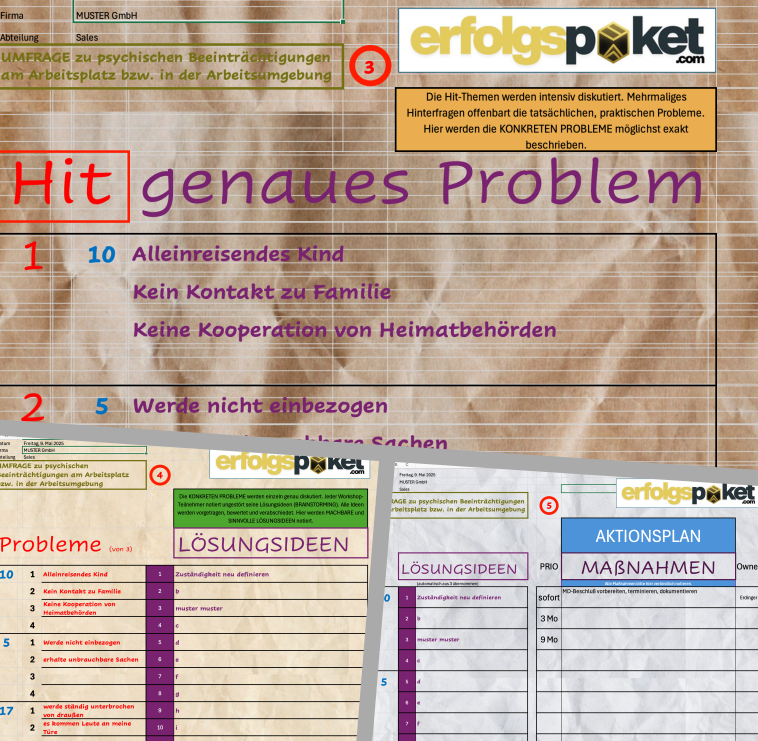
This article covers steps 6 to 9, which are worked through and completed in a workshop. Such a workshop meeting—perfectly prepared by a competent speaker and the contact person—takes only 70 to 90 minutes.
Workshop service description
Moderated evaluation and action workshop
(Risk assessment of psychological stress)
Aim of the workshop
The aim of the workshop is to jointly evaluate and classify the results of the employee survey on mental stress and translate them into concrete measures that can be implemented in the workplace. The workshop establishes the necessary link between statistical evaluation and practical improvement of working conditions.
Content and schedule
1. Introduction and clarification of objectives
At the beginning, the objective, framework, and legal classification of the psychological stress risk assessment are explained. Participants receive a clear introduction to the structure of the survey and the logic behind the evaluation.
2. Presentation of the evaluation results
The results of the survey are presented in a structured and comprehensible manner. Key points, notable findings, and correlations are explained without exposing individual persons or groups. The focus is on work-related stress factors, not on individual assessments.
3. Joint interpretation of the results
The results are classified in a moderated format together with selected employees and managers. Abstract survey values are translated into specific operational situations. The aim is to achieve a common understanding of the causes and causal relationships.
4. Derivation of appropriate measures
Based on the discussion, concrete measures to reduce psychological stress are developed. Technical, organizational, and personal approaches are taken into account. The measures are prioritized and evaluated in terms of their feasibility.
5. Documentation and recording of results
The results and measures developed in the workshop are documented in a structured manner. They form the basis for further follow-up measures and meet the requirements for a comprehensible risk assessment in accordance with the ArbSchG (German Occupational Safety and Health Act).
group of participants
The workshop is aimed at a limited, specifically selected group of employees, managers, interest groups, and, if applicable, the occupational safety specialist. The group is composed in such a way that different perspectives are taken into account without impairing the group's ability to work.
Added value of the workshop
The workshop ensures that the risk assessment of psychological stress is not reduced to a mere evaluation of data. It creates transparency, acceptance, and practical relevance, enabling employers to derive and implement effective and comprehensible measures.
delimitation
The workshop serves the purpose of work-related analysis and deriving measures. It does not replace individual counseling or therapy and is not diagnostic in nature.