

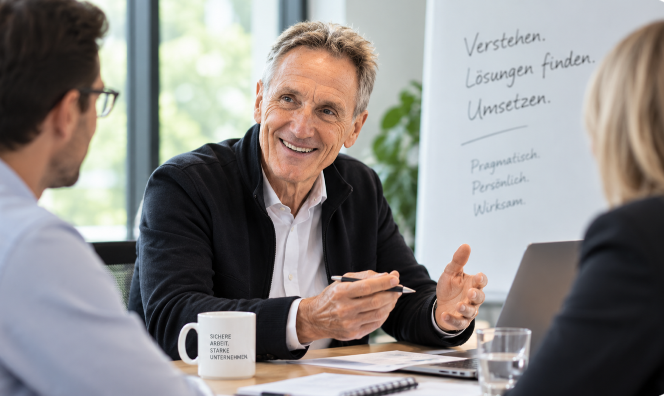
Occupational safety must work in day-to-day business operations. That’s why my work as an external occupational safety specialist doesn’t start with forms or checklists, but with your company: What do you do? How is your business organized? What’s already in place—and where is there actually a need for action?
My approach is personalized, pragmatic, and as straightforward as possible. Today, many tasks can be handled digitally. I’m on-site whenever a face-to-face conversation, an on-site inspection, or an assessment of actual working conditions is appropriate and necessary.
This is how occupational safety and health is achieved—not just on paper, but in practice within the company.
1. We start with the business—not with forms
To begin with, I would like to get to know your company. This includes the number of employees, business activities, and workstations, as well as your existing occupational safety and health management system, risk assessments, and measures taken to date.
Together, we’ll figure out: What’s already well organized? What’s missing? What needs to be updated? And what’s actually relevant to your business?
Only then can a meaningful plan for ongoing care be developed.
After all, an office requires different occupational safety measures than a manufacturing facility—and a company with 30 employees needs different support than one with 300.
2. As much as possible digitally—as much as necessary in person
Nowadays, providing effective security support doesn’t necessarily mean an in-person meeting for every discussion. Many coordination efforts, consultations, and organizational tasks can be handled quickly and efficiently online.
I’m on site whenever it makes professional sense: during facility tours, when specific questions arise about workstations and working conditions, or for one-on-one consultations with management, executives, the works council, and employees.
ASA meetings, too, can take place digitally, in a hybrid format, or in person, depending on the company. For me, it's not the format that matters, but the outcome.
My guiding principle: as much as possible digitally—and as much in person as necessary.
3. We develop risk assessments together
Risk assessments are not developed solely at the desk of the occupational safety specialist. They are developed in collaboration with the company. You know your workplaces, tasks, and operational processes—I contribute the methodology, structure, and expertise in occupational safety.
I work primarily digitally on my research. Depending on the topic, we use a CHECK with a suitable contact person at the company or a SURVEYwhen the experiences and perceptions of the employees themselves are important.
If this raises any questions that need to be clarified, we take a closer look—through a site visit, a discussion, a measurement, or a workshop. Only then do we assess the hazards and determine the necessary measures.
The form is merely a tool for gathering information—not the risk assessment itself.
Would you like to know what kind of support your company needs?
The required occupational safety support depends, among other factors, on the number of employees and the workplace hazards. Different support models apply to small businesses with up to 20 employees than to those with more than 20 employees.
Would you like to know what support services would look like in your company?
Just let me know the number of employees, the nature of your business, and your location. I’ll tell you what kind of support is needed, how I would organize it, and what costs you can expect.