

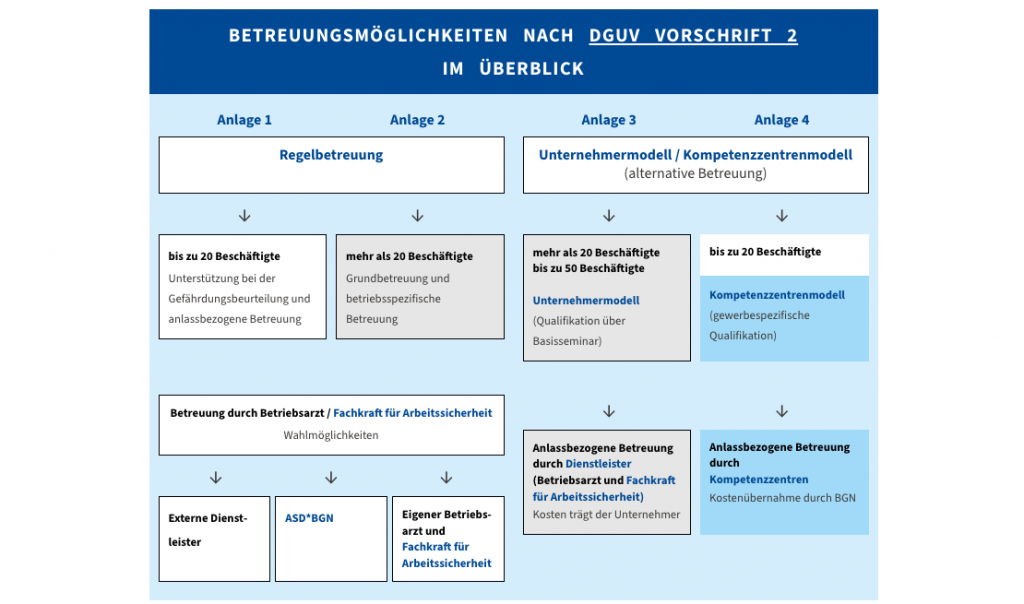
The cover image shows, as an example, the BGN’s care models
In a Nutshell: What Kind of Support Does My Business Need?
DGUV Regulation 2 distinguishes between standard care and alternative forms of care. The options available to a company depend in particular on its calculated number of employees and the regulations of the relevant workers’ compensation insurance provider.
For up to 20 employees, regular care as specified in Appendix 1 is possible. For companies with more than 20 employees, standard coverage is provided in accordance with Appendix 2, comprising basic coverage and company-specific coverage. For smaller companies, depending on the competent workers’ compensation insurance provider, alternative support models in accordance with Annex 3 or 4 may also be available.
Important: For the purposes of this classification, part-time employees are not always counted as full-time employees. As a result, two companies with the same number of actual employees may be classified under different care models.
The following article outlines the methodology and uses two examples to explain how to determine the number of employees relevant to your business.
What types of care models does DGUV Regulation 2 provide for?
DGUV Regulation 2 sets forth the various forms of occupational health and safety support in four appendices . It distinguishes between standard support and forms of alternative support .
The type of care that is appropriate for a company depends, in particular, on the number of employees and the regulations of the relevant workers' compensation insurance provider.
Appendix 1 – Standard Support Services for Businesses with Up to 20 Employees
The support services include, in particular, assistance with risk assessments as well as support tailored to specific situations.
Appendix 2 – Standard Support for Companies with More Than 20 Employees
The support consists of basic support and company-specific support.
Appendix 3 – Alternative Oversight
Accident insurance providers may offer alternative oversight models for companies with up to 50 employees. These include, for example, the employer-led model, in which the employer becomes more closely involved in occupational safety through qualification and continuing education programs.
Appendix 4 – Alternative Support for Businesses with Up to 20 Employees
Accident insurance providers may also offer special alternative support models for smaller businesses. One example is the BGN’s “Competence Center” model.
Important: The specific details of alternative care arrangements are not the same for all professional associations and accident insurance funds. The applicable DGUV Regulation 2 of the accident insurance provider responsible for the company is the governing authority.
What type of childcare is actually a viable option for my business?
The number of people employed is not always the decisive factor
When determining which type of childcare is appropriate for a business, the number of employees is of central importance. However, this does not simply involve counting the number of people employed by the company—that is, the number of “heads.”
Part-time employees are treated differently depending on their regular weekly working hours:
up to 20 hours: Factor 0.5
more than 20 to 30 hours: Factor 0.75
more than 30 hours: Factor 1.0
As a general rule, the average number of employees is the determining factor. As a result, a company may, for example, employ 25 people but, for the purposes of applying DGUV Regulation 2, still fall below the threshold of 20 employees when calculated.
This can be a decisive factor in determining which childcare options are available to the company.
Real-world example: 25 employees aren't always 25 employees
Two companies illustrate just how much the calculation of the threshold can affect the type of care provided. Both actually employ 25 people. However, DGUV Regulation 2 results in a different calculated number of employees.
Company A – 20 full-time employees and 5 part-time employees
The company employs 20 full-time employees as well as 5 part-time employeeswho regularly work between more than 20 and no more than 30 hours per week.
For the calculation, full-time employees are each assigned a weight of 1.0, and part-time employees with 0.75 are taken into account.
Calculation:
20 × 1.0 = 20
5 × 0.75 = 3.75
Calculated number of employees: 23.75
This means the company exceeds the threshold of 20 employees. It therefore falls under Appendix 2 of DGUV Regulation 2. The supervision consists of basic training and company-specific training.
Depending on the applicable workers' compensation insurer, a business of this size may also be eligible for alternative support arrangement in accordance with Appendix 3 . Key requirements include the active involvement of the business owner and the qualification specified by the respective workers’ compensation insurer.
Result: In this example, 25 actual employees result in 23.75 calculated employees —and thus to a support level above the 20-person threshold.
Company B – 2 full-time employees and 23 part-time employees
This company also employs 25 people. However, only 2 managers work full-time. The remaining 23 employees regularly work no more than 20 hours per week.
When calculating the threshold, each of these part-time employees is counted as 0.5 .
Calculation:
2 × 1.0 = 2
23 × 0.5 = 11.5
Estimated number of employees: 13.5
Although this company also employs 25 people, it is technically below the threshold of 20 employees. Therefore, for standard coverage, Appendix 1 of DGUV Regulation 2 applies. This includes assistance with risk assessments and the event-specific support derived from them.
Depending on the regulations of the applicable workers’ compensation insurer, companies of this size may also be eligible for alternative support models . The specific details vary by provider; therefore, the current version of the regulations issued by the employer’s designated workers’ compensation insurer always takes precedence.
Result: 25 people actually employed here result in only 13.5 calculated employees —and thus to a completely different classification.
The Key Difference
Company A and Company B each have 25 employees. However, Company A’s average number of employees is 23.75, while Company B’s is only 13.5.
Therefore, the number of employees at the company is not the only factor that determines how many people work at the company, but rather how the number of employees is to be calculated according to the guidelines of DGUV Regulation 2.
Threshold and Care Model
For the purpose of calculating the threshold, Section 2(5) of DGUV Regulation 2 stipulates that part-time employees must be weighted according to their regular weekly working hours. Employees working no more than 20 hours per week are weighted at 0.5, employees working more than 20 but no more than 30 hours per week are weighted at 0.75, and employees working more than 30 hours per week are weighted at 1.0. Annual averages are used for this calculation.
Important: This standardized calculation of the threshold must be distinguished from the specific details of the possible care models. These details may vary depending on the competent workers’ compensation insurer.