
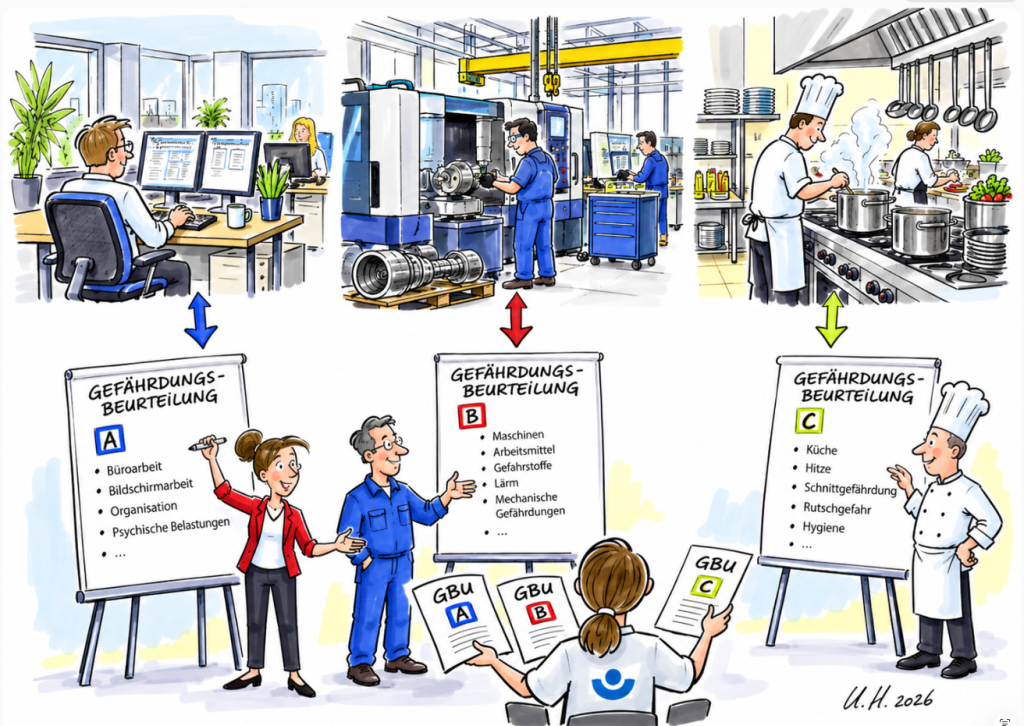
The risk assessment in occupational safety is the central tool of workplace safety. According to Section 5 of the Occupational Safety Act, the employer must identify and assess the hazards associated with the work and determine the necessary protective measures based on that assessment.
The risk assessments required depend on the activities, workstations, and actual working conditions at the company . Therefore, an office requires a different focus than a production facility or a restaurant.
This page provides an overview: What risk assessments are required? How are hazards identified? When should employees be involved—and how can the results be turned into effective measures?
One of the four main topic pages on occupational safety
This page provides an overview of risk assessment and directs you to relevant technical articles and practical resources.
In this post
01 – What risk assessments does my company need?
Not every company needs the same risk assessments. Some topics are practically standard components of workplace safety and health, while others arise from the activities, work equipment, hazardous substances, and specific working conditions within the company.
What matters, therefore, is not having the longest possible list of risk assessments, but rather the question: What hazards could arise from the activities actually being performed?
You can find an overview of basic risk assessments and additional company-specific risk assessments here:
02 – How Are Hazards Identified?
Hazards cannot always be identified using the same method. Depending on the issue and working conditions, a structured inspection, employee surveys, a site visit, an interview, or a measurement be the appropriate method.
For many topics, I use a CHECK in collaboration with an appropriate contact person at the company. A SURVEY is particularly useful when the experiences and perceptions of the employees themselves are needed as a source of insight.
03 – When should employees be involved?
Not every hazard can be adequately identified through an inspection, measurement, or structured assessment alone. For some issues, the experiences and observations of the employees themselves are an important source of insight.
This is especially true when working conditions are experienced on an individual basis or when differences in actual work processes are difficult to discern from the outside—for example, in the case of psychological and mental stress, work organization, computer-based and office work, working from home, or software ergonomics.
Depending on the research question, participation can take the form of a SURVEY, interviews, or a facilitated workshop .
04 – From Investigation to Risk Assessment
The form is a diagnostic tool—not the risk assessment.
An inspection, a survey, a site visit, or a measurement initially provides information about potential hazards. These results must then be specified and evaluated . Based on this, appropriate protective measures are determined, responsibilities and deadlines are established, and the measures are implemented.
Finally, it is necessary to determine whether the measures have actually achieved the desired effect.
Identify → Define in detail → Evaluate → Determine actions → Assign responsibility and set a deadline → Implement → Monitor effectiveness
A risk assessment is not a document that is created once and then filed away. It must be tailored to the actual working conditions and reviewed or updated whenever there are significant changes to workstations, work procedures, equipment, hazardous substances, or activities, or whenever new information about hazards becomes available.
Accidents, near misses, or other special events may also be reasons to review the risk assessment.
05 – When Is a Workshop Needed?
Not every risk assessment requires a workshop. It is particularly useful when an identified issue cannot be explained solely on the basis of data, an on-site inspection, or a technical assessment and the employees’ practical knowledge is needed.
During the workshop, issues are identified in detail, possible causes are examined collaboratively, and appropriate solutions are developed. This process transforms general findings into specific problems and, ultimately, actionable measures.
This method is particularly well-suited, for example, to mental stress, work organization, collaboration, computer and office work, or other complex work processes.
06 – Risk Assessment for Computer Work
Computer and office work are among the most common activities in companies. The risk assessment considers not only the workstation itself, but also the computer screen, work equipment, work environment, work organization, and the software used. It also vision problems and occupational health care must be taken into account.
For office workstations, home offices, and mobile work, hazards can be identified in a structured manner using a CHECK or by conducting a SURVEY of employees.
07 – Risk Assessment of Psychomental Stressors
Psychological and mental stressors are among the hazards that must be taken into account as part of the risk assessment. This does not involve assessing individual employees, but rather designing working conditions—such as work intensity, work organization, scope for action, social relationships, or the work environment.
It is precisely here that the employees’ experiences are an important source of insight. With CARRARA, this information is first collected anonymously, analyzed in a structured manner, and then jointly refined in a workshop. This process results in specific actions with assigned responsibilities and deadlines, as well as a subsequent assessment of their effectiveness.
Do you have a question about workplace safety?
Please briefly describe your request. I will get back to you personally.