
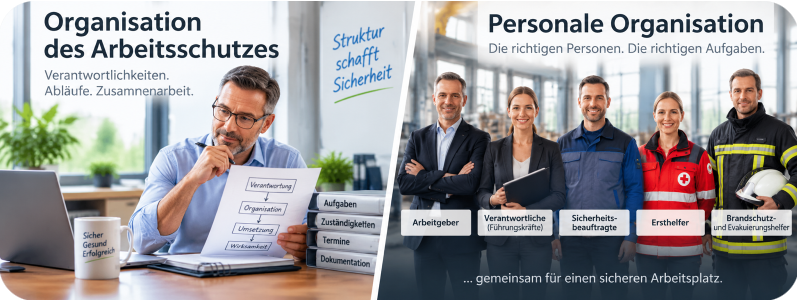
Occupational safety must be organized within the company. Risk assessments and training alone are not enough. It must also be clearly defined who is responsible, who supports the employer, and how the parties involved work together.
On the staffing of the occupational safety and health organization includes, depending on the size and structure of the company, responsible managers, safety officers, first aid responders, and fire safety and evacuation assistants, among others. Duties and areas of responsibility must be clearly defined and, if necessary, formalized in a written assignment of duties if necessary.
Equally important is the organizational structure: The occupational safety specialist and the company physician must be involved, site inspections must take place regularly, and in larger companies, the Occupational Safety Committee (ASA) discusses current issues and necessary measures.
On this page, you'll find an overview: Who is responsible for what? What operational roles are needed? How can tasks be delegated effectively? And what regular procedures ensure that occupational safety is consistently maintained within the company?
01 – Who is responsible for workplace safety?
Responsibility for occupational safety and health lies primarily with the employer. The employer must ensure that the necessary measures are taken, appropriate structures are put in place, and legal requirements are implemented within the workplace.
However, occupational safety is not a responsibility that an employer can handle alone in larger or more complex companies. Even managers and other individuals entrusted with operational responsibilities also bear responsibility within the scope of their duties and authority. It is therefore crucial that responsibilities within the company are clearly defined.
The occupational safety specialist and the company physician advise and support the employer and the responsible individuals. However, they do not assume the employer’s business responsibilities. Safety officers also have a supporting role and are generally not additional members of management.
An effective occupational safety and health program therefore begins with a simple question: Who is responsible for what in which area?
In larger, project-oriented, or organizationally structured companies, it may be advisable or necessary to explicitly assign tasks and areas of responsibility to appropriate individuals. This is the purpose of the written delegation of dutiesserves this purpose.
02 – Delegation of Duties: Clearly Assigning Responsibility
In larger, structured, or project-oriented companies, the employer may delegate certain occupational safety and health tasks and responsibilities to reliable and knowledgeable individuals . Typical examples include managers responsible for individual locations, departments, production areas, or projects.
Such a delegation of duties should be in writing and clearly describe the scope of responsibility. It is not sufficient to merely assign “responsibility for occupational safety and health” to a person. It must be clear which tasks they are taking on and what authority they haveto actually carry out these tasks.
This may include, for example, the authority to issue instructions and make decisions, organizational responsibilities, or the ability to initiate necessary measures. Responsibility and the scope for action must be aligned.
The delegation of duties does not completely relieve the employer of its responsibility. The employer must select suitable individuals, organize the work appropriately, and ensure that the delegated tasks are carried out.
Well-organized occupational safety and health therefore does not require as many people in charge as possible, but rather clear responsibilities and sufficient authority.
How to Properly Structure a Transfer of Responsibilities
What should a written transfer of responsibilities include—and what should a manager check before signing it?
→ Templates and Guidelines for the Transfer of Responsibilities
03 – Safety Officers: Support from the Workplace
Safety officers assist employers and employees with workplace safety. They are familiar with their work areas from day-to-day practice and can therefore draw attention to hazards, unsafe work practices, or missing safety measures at an early stage.
Safety officers are not managers and generally have no authority to issue instructions. Nor do they bear the responsibility of the occupational safety specialist. Rather, their particular strength lies in the fact that they work directly within the company, collaborate with their colleagues, and support occupational safety in day-to-day work.
Whether safety officers are required—and, if so, how many—depends, among other things, on the number of employees, workplace hazards, and the company’s organizational structure . When selecting a safety officer, care should be taken to ensure that the person is familiar with the respective work area and is accepted by the employees.
To perform their duties, safety officers need appropriate certification. Relevant seminars are offered primarily by the employers’ liability insurance associations and accident insurance funds.
Well-chosen safety officers are not an additional layer of hierarchy—they are key points of contact for ensuring safety in day-to-day work right on the job site.
Safety Officers at
When must safety officers be appointed, how many are needed, and what are their duties, rights, and qualifications?
→ Safety Officers: Responsibilities, Number, and Qualifications
04 – Organize First Aid, Fire Safety, and Evacuation
In case of an emergency, the employer must determine in advance who will provide assistance and how to respond. This includes, in particular, organizing first aid as well as measures for fire emergencies and any necessary evacuation.
For the first aid , there must be a sufficient number of trained first aid responders available. In this regard, it is not only the number of employees that must be taken into account: vacation time, sick leave, shift work, and different locations must also be factored in so that first aid responders are actually present in the event of an emergency.
Also for the fire safety , suitable employees must be designated and trained. The required number of fire safety assistants is determined by the risk assessment; under normal operating conditions, the ratio is approximately five percent of the workforce is generally sufficient.
Emergency planning also includes evacuation. Procedures must be established for how employees and other people present can safely leave the building in the event of a hazard, who will assume specific responsibilities during the evacuation, and, in particular, how to accommodate people who require assistance.
What matters is not whether names are on a list. In an emergency, there must actually be sufficiently qualified people available who know what to do.
Organizing First Responders and Fire Safety Officers Effectively
Who is responsible for training, who covers the costs, and how can the required qualifications be obtained with minimal organizational effort?
05 – Occupational Safety Specialist and Company Physician
When it comes to occupational safety, the employer must rely on occupational safety specialists and company physicians . Both roles complement each other but have different areas of expertise.
The Occupational Safety Specialist (Sifa) provides advice, in particular, on the design of workstations and work processes, risk assessments, protective measures, the organization of occupational safety, and the investigation of workplace accidents. They regularly monitor the company’s operations and assist in identifying and implementing necessary measures.
The occupational physician provides the occupational health perspective. This includes, among other things, advising on the health effects of work, occupational health screenings, and issues related to the ergonomic and health-conscious design of working conditions.
Both provide the employer with expert advice. However, they do not assume the responsibility of the employer or the responsible managers.
The nature and scope of supervision depend on the company’s circumstances and the requirements of the Occupational Safety Act (ASiG) and DGUV Regulation 2.
Effective occupational safety and health is achieved when employers, managers, occupational safety specialists, and company physicians work together rather than side by side.
06 – Occupational Safety Specialist and Company Physician: Consulting Together
Occupational safety specialists and company physicians view occupational safety from different perspectives. The occupational safety specialist primarily contributes the technical and organizational perspective, while the company physician contributes the occupational health perspective. Many workplace issues are therefore best assessed collaboratively.
This applies, for example, to the workstation design, ergonomic stressors, psychological and mental stressors, hazardous substances, and the derivation of necessary occupational health preventive measures from the findings of the risk assessment.
In practice, therefore, not all tasks need to be handled jointly. What matters most is that both sides are aware of what is happening within the company, coordinate their efforts on overlapping issues, and consult with one another as needed.
For the employer, this means that the role of a qualified specialist and that of a company physician should not be viewed as two separate mandatory appointments. Their collaboration is an integral part of a well-functioning occupational safety and health organization.
How this collaboration takes place within a company depends on the company’s size, the hazards involved, and its organizational structure. An important forum for collaboration—where required by law—is the Occupational Safety Committee (ASA).
07 – Site Inspections: Checking Occupational Safety On-Site
Regular workplace inspections link occupational safety and health management with day-to-day operations. During these inspections, workstations, work areas, and tasks are examined, and a joint assessment is made to determine whether existing safety measures are effective and where action is needed.
Depending on the occasion and the company, the following individuals may participate in an inspection: occupational safety specialist, the company physician, managers, safety officers, the employee representative body, and other responsible individuals be involved.
A site inspection is not only intended to identify obvious deficiencies. It also provides an opportunity to speak with employees and managers, to identify changes in the workplace, and to verify whether risk assessments, training, and organizational procedures still align with the actual work situation.
Identified actions should then be documented, assigned to responsible parties, scheduled, and tracked until completion. Only then does an inspection become an effective tool for occupational safety and health.
Workplace inspections are therefore not a one-time assessment, but rather a regular review to determine whether the organized occupational safety and health measures are actually effective in day-to-day operations.
Workplace Inspections in Practice
Why regular inspections are essential for effective occupational safety and what companies should keep in mind when conducting them, documenting the results, and following up on corrective actions.
08 – Occupational Safety and Health Committee (ASA): Discussing Occupational Safety and Health Together
In companies with more than 20 employees , an occupational safety committee—or ASA —must be established. Its task is to regularly discuss occupational safety and accident prevention issues as a group.
The ASA consists of the the employer or a representative appointed by the employer, two members of the works council, the company physician, the occupational safety specialist, and safety officers. Depending on the topic, other company experts or responsible parties may be consulted.
The Occupational Safety and Health Committee meets at least once a quarter . Topics discussed include, for example, the results of facility inspections and risk assessments, accidents and irregularities, necessary protective measures, occupational health issues, and changes to workstations and work processes.
A well-organized ASA should not be merely a mandatory event . It makes sense to have a clear agenda, a reasonable meeting duration, and, above all, clear documentation: What was decided? Who is responsible for it? By when should the measure be implemented?
When used properly, the ASA serves as the regular collaborative forum for workplace safety.
09 – Tracking Actions: Turning Planning into Action
Workplace safety does not end with a meeting, a site inspection, or a risk assessment. What matters most is that any identified need for action is subsequently addressed.
For necessary measures, the following should therefore be clearly defined: What needs to be done? Who is responsible? By when should the action be completed? Afterward, it must be verified whether the action was actually completed and whether the desired effect was achieved.
These measures can stem from a wide variety of sources—for example, from hazard assessments, facility inspections, ASA meetings, accident analyses, reports from employees, or consultations with the occupational safety specialist and the company physician.
Especially when there are several open items, a centralized and transparent track of actions is particularly useful. This ensures that tasks don’t get lost among meeting minutes, emails, and individual responsible parties.
Effective occupational safety and health management, therefore, involves more than just defining responsibilities. It also ensures that identified tasks are carried out, documented, and evaluated for effectiveness.
10 – Good organization makes workplace safety effective
Occupational safety works well when responsibility, support, and regular procedures are integrated. The employer establishes the organizational framework, managers assume responsibility in their respective areas, and the occupational safety specialist and company physician provide advice and support.
Safety officers, first aid responders, and fire safety assistants directly support this structure in day-to-day operations. Facility inspections and the occupational safety committee ensure that problems are identified, discussed, and that necessary measures are implemented.
What matters here is not the number of forms and documents. What matters is that responsibilities are clearly defined, tasks are actually carried out, and agreed-upon measures are followed through until they are implemented.
This is how individual legal obligations come together to form a a well-functioning occupational safety and health system—one that is clear, transparent, and tailored to the company.
Do you have a question about workplace safety?
Please briefly describe your request. I will get back to you personally.