

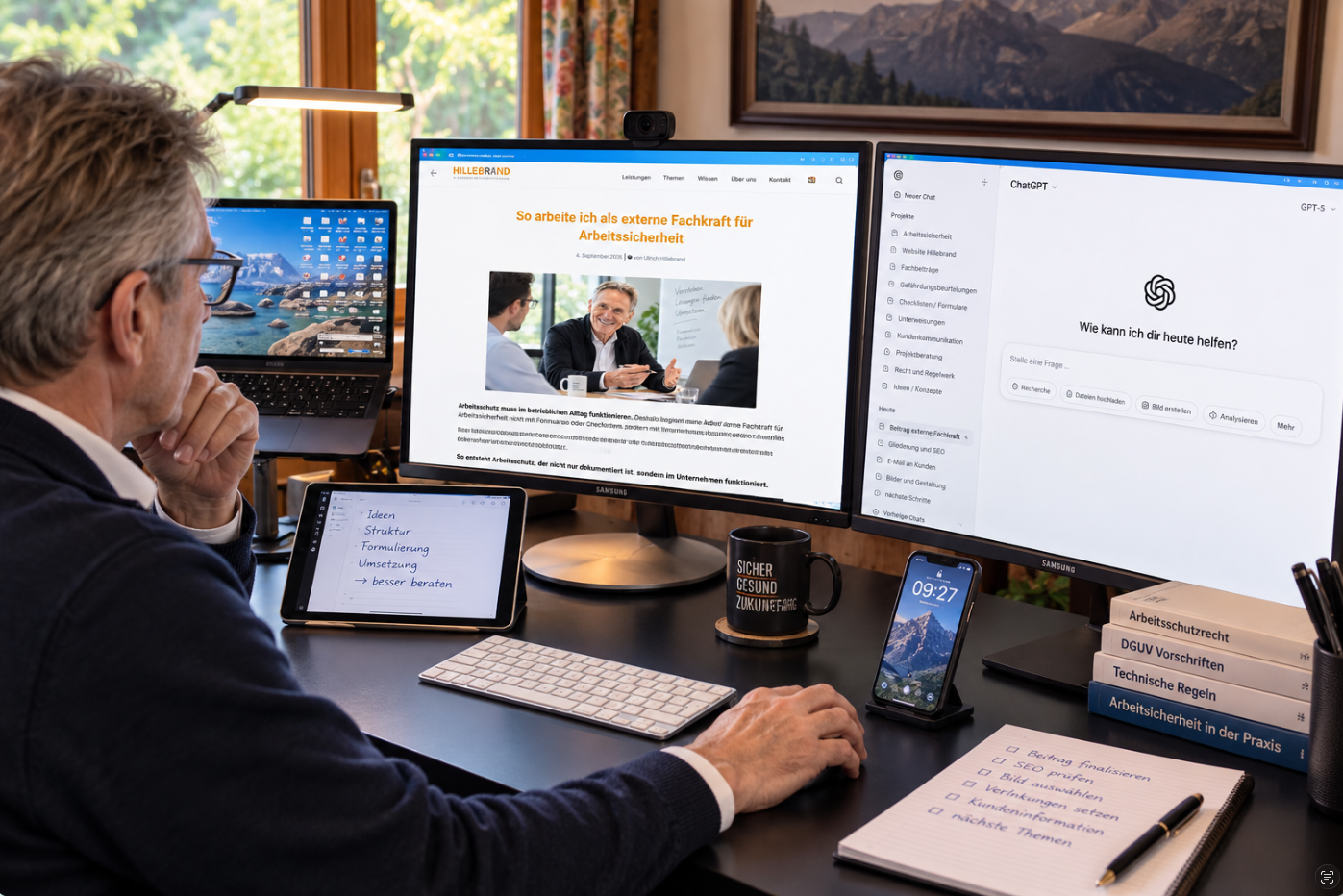
Effectively Combining Personal Experience, Digital Processes, and AI
Occupational safety is and will always be a consulting task. It is essential to understand workplace situations, assess hazards, and develop practical solutions in collaboration with those responsible.
The way in which this work is prepared, carried out, and documented has, however, changed fundamentally.
For me, digital tools and artificial intelligence are therefore not just an add-on to an otherwise traditional way of working. They have become an integral part of many work processes—from the initial idea through research and investigation to documentation, communication, and knowledge transfer.
When used correctly, digitalization does more than just speed up workflows. It accelerates thought processes, enables the linking of information, and improves the quality of results.
In this regard, another principle applies to all systems used:
Digitalization requires data protection.
01 – AI supports thinking—it does not replace professional responsibility
I use ChatGPT for virtually all tasks where AI support makes sense from both a technical and practical standpoint.
This process begins with structuring a question and extends through research and expert reviews to the drafting of statements, risk assessments, customer information, emails, forms, and technical articles.
AI also helps me further develop my website, link existing knowledge resources, and create new digital workflows.
This creates a synergy:
Professional experience and expert assessment → AI-supported analysis and structuring → expert review → practical implementation.
AI does not determine the safety of a workplace and assumes no responsibility. The technical assessment and responsibility remain with me as the occupational safety specialist.
02 – An Example: How an Idea Becomes an Occupational Safety Process
A practical example illustrates better than any list of software what I mean by a digital way of working.
It all starts with just a thought:
Delegating occupational safety and health responsibilities to managers is important for the effectiveness of the occupational safety and health system. Are my clients sufficiently informed about this?
This topic may have already been discussed during facility inspections or in consulting meetings. But was its significance truly understood? Are the existing regulations still up to date? And how can I explain this topic in a way that allows a business owner to take the time to understand it and then take action?
This is where the digital workflow begins.
Together with ChatGPT, I develop a structured knowledge article based on the initial technical concept. Legal foundations, accountability structures, responsibilities, authorities, and limitations of the delegation of duties are systematically organized and then reviewed by me for technical accuracy.
The finished article will become part of the "Knowledge" section of my website and will be linked there to other topics related to occupational safety and health management.
Next, the client companies are selected based on whether the topic is relevant to their size and management structure. Individual client communications via email are also developed with AI support.
This means the customer doesn't just receive a form, but first and foremost insight and a concrete reason to review their own organization. The article then provides a template as a PDF and an editable Word file.
And when this gives rise to a specific business issue, the digital process ends where in-person consultation becomes necessary:
"Let's work together to determine how responsibilities and authorities should be appropriately structured within your company."
To me, that’s what digitalization in occupational safety is all about: A technical idea is transformed into knowledge more quickly; knowledge leads to communication; and communication can result in concrete operational improvements.
03 – Shared Documentation in Nextcloud
For medium-sized and larger clients, I set up a dedicated area in my Nextcloud.
A defined folder structure reflects the key areas of collaboration. The client is granted appropriate access and editing rights and can upload documents on their own. Conversely, the documents created as part of the project are centrally available there.
This avoids a confusing back-and-forth of ever-changing file versions via email and instead creates a shared digital workflow and documentation structure.
Documentation Becomes Management Information
Structured filing isn't just for finding documents. Folders and documents can also be labeled according to their processing status—for example, as pending, in progress, or completed.
I also use this status information for my annual review. The existing and processed items are systematically recorded and weighted. This results in a score reflecting the current status of the occupational safety organization.
The metric itself is not the goal. What matters is the subsequent professional assessment: Where are there still gaps? Which topics offer particular potential for improvement? And which tasks should be prioritized in the coming support period?
In this way, a digital document structure becomes a tool for the continuous improvement of workplace safety.
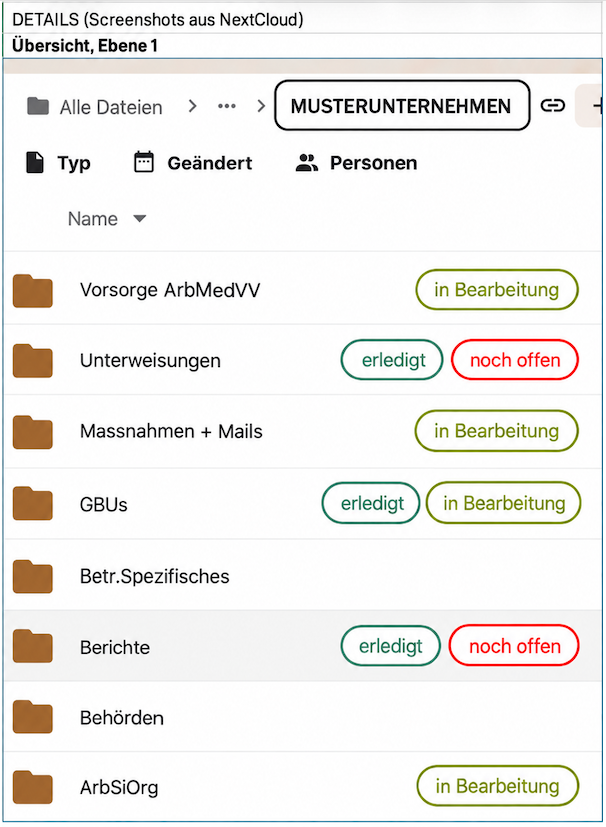
The folder structure (top level) in Arbeitssicherheit Hillebrand's NextCloud, with tags.
04 – Identifying Hazards Digitally
For many risk assessments, I use Microsoft Forms as a data collection tool.
I make a distinction between CHECK and SURVEY.
In the CHECK process, operational issues are identified in a structured manner with the assistance of an appropriate contact person. In the SURVEY process, employees are directly involved when their perceptions and experiences are necessary for the assessment.
The same applies here:
The digital form is not the hazard assessment.
It provides information. Any findings are then clarified, professionally evaluated, and, if necessary, explored in greater depth through site visits, interviews, measurements, or workshops.
05 – From the Survey to the Action Plan
Digitalization has made particularly significant strides in projects involving the assessment of psychological stress risks, as well as in surveys regarding the workplace and work environment.
Using the CARRERA method , survey results are evaluated in a structured manner. Notable findings and free-text responses are identified and prepared for further processing.
But here, too, digitalization doesn't end with a statistic.
The results are incorporated into a workshop. Problems are clearly defined and prioritized, possible solutions are developed, and finally, actions, responsible parties, and deadlines are established.
Digital investigation and analysis—understanding and improving together.
06 – Digital Learning: From Instruction to Assessment
The technical content of the training modules is developed and formatted with the help of AI. The long-form texts are converted into HeyGen . The accompanying comprehension questions and quizzes can, in turn, be developed using ChatGPT.
The learning content is provided via akademie.erfolgspaket.com.
After processing, the necessary quiz and results data are processed securely and stored on the appropriate server infrastructure. The results can ultimately be used to generate the documented proof or certificate.
Thus, the digital chain extends from the development of the educational content through its multimedia delivery and assessment of learning outcomes to the documented result.
07 – Data Protection Is Not an Add-On Module
Digital work processes only function effectively if there are rules in place specifying what data is processed, where it is stored, and who is authorized to access it. That’s why I believe data protection is an integral part of the digital way of working—it’s not something that’s added as an afterthought.
One example is the shared documentation in my IONOS Managed Nextcloud. A data processing agreement is in place with IONOS for the processing of personal data. Processing is carried out in accordance with the underlying technical and organizational measures within the EU or the EEA.
Access to Nextcloud is protected and is restricted to authorized users only. Data transmission is encrypted. For each of the companies we serve, there are separate client and folder structures with corresponding access permissions. Customer data is thus logically separated from one another and is not shared across the entire system.
Availability and technical security are also integral parts of this concept. These include, among other things, regular data backups, redundant systems, firewall and DDoS protection, monitoring, and regular security updates.
To me, data protection doesn’t mean giving up digital possibilities. It means consciously choosing digital tools and considering data processing, access rights, and technical safeguards from the very beginning.
Working digitally also means thinking about what data is processed, where it is processed, who has access to it, and how it is protected.
08 – Digital, Because It Makes Work Better
I don't digitize my work just because digital tools seem modern.
I use them because they allow me to respond more quickly to my clients’ questions, better connect pieces of knowledge, analyze issues more thoroughly, and document results in a more transparent manner.
Artificial intelligence significantly expands these possibilities. It can organize information, reveal connections, develop alternatives, and speed up communication.
But she doesn't know how the business works.
It does not determine whether a specific safety measure works in practice. It does not assume responsibility for a technical assessment. And it does not replace dialogue with the people in the company.
That is why the guiding principle of my work remains:
Think digitally. Work systematically. Provide personalized advice.
Would you like to organize workplace safety more easily and digitally?
Please briefly describe your request. I will get back to you personally.